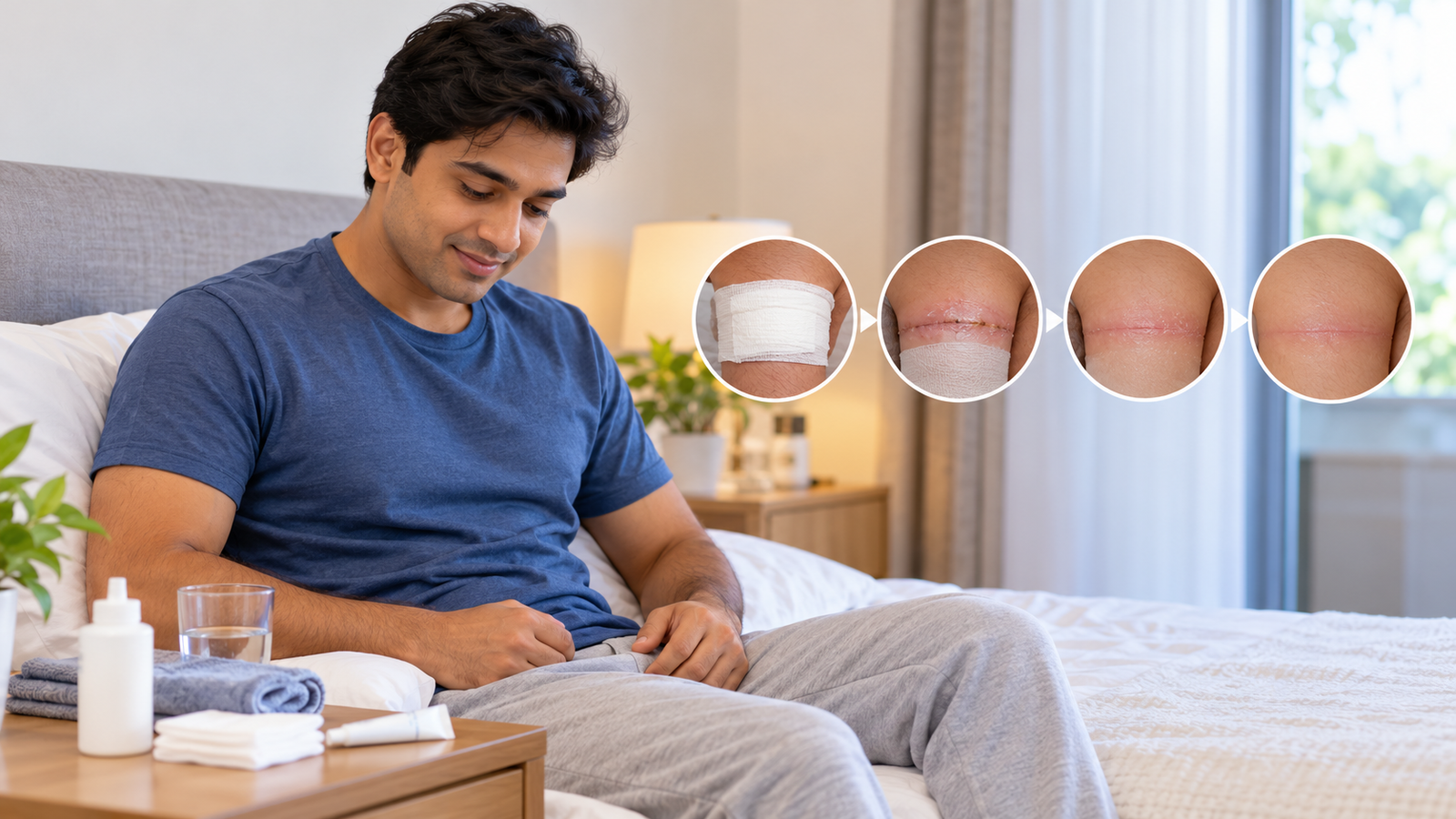

Travelling from Ahmedabad for Circumcision in Surat: Planning Surgery and Review in Two Trips
Patients travelling for circumcision can sometimes complete consultation, medical tests and day-care surgery during one visit, followed by a planned review approximately one week later. However, same-day surgery, next-day travel and remote follow-up depend on medical fitness, the surgical technique and early healing. Some patients need an overnight stay or additional in-person reviews.
Many men compare circumcision techniques, surgeon experience, treatment costs and recovery arrangements before selecting a clinic.
For patients travelling from another city, the decision involves more than choosing a surgical technique. They must also consider medical reports, travel arrangements, accommodation, wound care and follow-up appointments.
A well-organised treatment plan can reduce unnecessary journeys without compromising safety.
This guide explains how patients can prepare for circumcision, what happens during the first visit, when they may travel home, and how to arrange follow-up care.
Circumcision in Ahmedabad: Why Do Some Patients Consider Travelling for Surgery?
Patients researching circumcision in Ahmedabad may compare local treatment options with clinics elsewhere based on surgical expertise, available techniques, consultation arrangements, and postoperative support.
Some patients prefer a surgeon who regularly performs adult circumcision procedures.
Others want to understand the differences between conventional circumcision, stapler-assisted surgery and other techniques before making a decision.
Travelling for surgery may be reasonable when patients can arrange safe transportation, suitable accommodation and reliable postoperative care.
However, travelling is not automatically better than receiving treatment locally.
Patients should prioritise the surgeon's qualifications, appropriate treatment recommendations, complication-management arrangements and access to follow-up care.
Can Consultation and Circumcision Surgery Happen on the Same Day?
Yes, selected patients may undergo consultation and circumcision on the same day.
However, the surgeon must first confirm that the patient is medically suitable.
Same-day surgery depends on several factors:
-
The patient's general health and medical history
-
The condition of the foreskin and surrounding tissue
-
The presence of infection or inflammation
-
Required medical investigations
-
The planned surgical technique
-
Anaesthesia requirements
-
Availability of the operating facility
For example, a healthy adult with uncomplicated phimosis may qualify for a planned day-care procedure.
However, a patient with uncontrolled diabetes, active infection or another medical concern may require treatment or further investigations before surgery.
Same-day consultation does not guarantee same-day surgery.
Patients should share their medical history with the clinic before travelling.
Which Medical Reports Should You Prepare Before Travelling?
Preparing medical information in advance helps the surgical team assess whether the patient needs additional tests.
Not every patient requires the same investigations.
The surgeon selects tests according to the patient's age, health, medicines, and planned anaesthesia.
Common Preoperative Information
| Information or Test | Why It Matters |
|---|---|
| Medical history | Identifies existing health conditions |
| Current medicines list | Helps identify medicines that may affect surgery or bleeding |
| Diabetes history and glucose results | Helps assess blood glucose control |
| Blood pressure information | Supports anaesthesia and surgical planning |
| Blood tests, when indicated | Checks relevant medical risks |
| Previous surgery records | Helps identify complications or anaesthesia concerns |
| Allergies | Helps prevent medication-related reactions |
| Clinical photographs, if requested | May support preliminary assessment but cannot replace examination |
Patients taking blood thinners should inform their surgeon before travelling.
They must not stop prescribed medicines without instructions from the treating clinician.
Patients can review the clinic's tests before circumcision information and confirm which reports they should arrange.
Can You Send Reports Before the Appointment?
Many clinics can review available medical documents before an in-person consultation.
Patients should ask which secure communication method the clinic accepts.
A preliminary review may help identify missing reports, but the surgeon must still perform an appropriate examination before confirming treatment.
Two-Trip Circumcision Surgery Planner
A two-trip arrangement may work for selected patients with uncomplicated surgery and satisfactory healing.
The following checklist explains how to organise the process.
| Stage | Patient Checklist | Important Considerations |
|---|---|---|
| Before travel | Share medical history, current medicines, allergies and available reports | Confirm whether additional investigations are necessary |
| First visit: Consultation | Attend examination and discuss surgical options | Surgeon confirms whether surgery is appropriate |
| First visit: Surgery | Complete consent, anaesthesia assessment and procedure | Same-day surgery depends on medical suitability and scheduling |
| Before discharge | Collect prescriptions, wound-care instructions and emergency contact details | Confirm warning signs and travel restrictions |
| Travel home | Arrange comfortable transport and an accompanying adult if required | Avoid driving immediately after anaesthesia or while taking sedating medicines |
| Around day 7 | Attend the planned postoperative review | The surgeon determines whether video or in-person assessment is appropriate |
| Additional review | Seek examination if healing is delayed or symptoms develop | Extra visits may be necessary |
| Emergency plan | Identify the nearest emergency hospital before returning home | Do not delay urgent care while waiting for a remote response |
The schedule is an example rather than a guaranteed treatment package.
Patients should follow the individual plan provided by their surgeon.
For additional preparation guidance, visit the clinic's out-station patient information page.
What Happens During the First Visit?
The first visit usually begins with a consultation.
The surgeon examines the foreskin, discusses the patient's symptoms, and checks whether circumcision is medically appropriate.
Step 1: Medical Examination
The doctor evaluates problems such as:
-
Phimosis or tight foreskin
-
Recurrent foreskin inflammation
-
Painful foreskin retraction
-
Scarring or skin disease
-
Previous foreskin surgery
-
Other conditions requiring specialist evaluation
The examination helps determine whether circumcision, conservative treatment, or another procedure is appropriate.
Step 2: Choosing the Surgical Technique
The surgeon explains the available options and recommends a technique based on the patient's anatomy and medical needs.
Step 3: Surgery and Observation
If the patient qualifies for surgery, the team completes the procedure using the planned anaesthesia.
Afterward, the staff monitors the patient for bleeding, pain, and immediate complications.
The patient receives discharge instructions when the clinical team confirms that discharge is safe.
Step 4: Planning the Return Journey
Before leaving, patients should ask when they may travel, whether they need an accompanying adult, and what symptoms require urgent care.
Stapler vs Conventional Circumcision for Travelling Patients
Patients often compare stapler-assisted circumcision with conventional surgical circumcision.
Both techniques remove the foreskin, but the instruments and wound-closure methods differ.
| Feature | Stapler Circumcision | Conventional Circumcision |
|---|---|---|
| Technique | Uses a specialised circumcision device | Surgeon removes foreskin using surgical instruments |
| Wound closure | Device places staples during the procedure | Surgeon generally closes the wound with sutures |
| Procedure duration | May be shorter in selected cases | Depends on surgical complexity |
| Postoperative swelling | Can occur | Can occur |
| Follow-up | Must check wound healing and staple status | Must check wound healing and sutures |
| Additional removal | Some retained staples may require removal | Absorbable sutures usually dissolve over time |
| Suitability | Depends on anatomy and device availability | Suitable for many patients, including selected complex cases |
Neither technique eliminates the need for postoperative care.
Patients considering stapler-assisted surgery should ask how the surgeon handles retained staples and whether local follow-up arrangements are available.
Read more about stapler circumcision for adults.
Is It Safe to Travel Home the Next Day?
Some patients can travel home the day after uncomplicated circumcision.
However, the surgeon must confirm that the patient is medically stable.
A journey of approximately four to five hours may be manageable for selected patients, but actual travel time and comfort vary.
Tips for Comfortable Travel
Choose comfortable, loose-fitting clothing.
Follow the surgeon's instructions about dressings and wound protection.
Use prescribed pain medication as directed.
Avoid lifting heavy luggage or placing unnecessary pressure on the operated area.
Take breaks during long journeys when practical.
A small cushion may improve sitting comfort, provided it does not press directly against the surgical site.
Patients should avoid driving while recovering from sedation or general anaesthesia, or while taking medicines that impair alertness.
If the patient experiences significant bleeding, worsening pain or other concerning symptoms, they should seek medical assessment before travelling.
Do You Need to Stay Overnight After Circumcision?
Not every patient needs an overnight hospital admission.
Adult circumcision often takes place as a day-care procedure.
However, patients travelling long distances may benefit from staying nearby overnight.
An overnight stay may be particularly useful when:
-
Surgery finishes late in the day
-
The patient receives sedation or general anaesthesia
-
Pain or swelling requires observation
-
The patient has additional medical conditions
-
The surgeon recommends delaying travel
Patients should confirm accommodation arrangements before their appointment.
The clinic should also explain whether the patient needs an accompanying adult after anaesthesia.
Can Your Follow-Up Review Happen Through Video Consultation?
Some postoperative concerns can be discussed through video consultation or securely shared photographs.
Remote reviews may help the surgeon assess reported symptoms and visible wound changes.
However, video assessment has limitations.
The surgeon cannot reliably examine every aspect of wound healing remotely.
When Is an In-Person Review Necessary?
Patients may need an in-person examination when they develop:
-
Increasing swelling
-
Persistent or worsening pain
-
Bleeding that does not settle
-
Pus or concerning discharge
-
Wound separation
-
Fever or spreading redness
-
Retained staples that require assessment
Patients should not attempt to remove staples or sutures themselves.
The surgeon should explain when a local qualified clinician can provide follow-up care and when the patient must return for specialist assessment.
What About Staples Remaining After Two Weeks?
Some circumcision devices use staples that detach as healing progresses.
The timing varies between patients and devices.
If staples remain after approximately two weeks, patients should contact their surgeon for guidance rather than attempting removal at home.
Not every retained staple represents an emergency, but persistent staples, pain, embedding or inflammation may require examination and removal by a qualified clinician.
The exact review schedule should follow the operating surgeon's instructions.
What Should You Do if a Problem Starts After Returning Home?
Patients should keep their discharge summary, prescriptions, and clinic contact information readily available.
Minor swelling and discomfort can occur during normal healing.
However, symptoms that worsen rather than improve may indicate a complication.
Seek Urgent Medical Attention For:
-
Heavy or persistent bleeding
-
Inability to pass urine
-
Severe or rapidly increasing swelling
-
Fever with increasing wound pain or redness
-
Significant wound separation
-
Severe pain that prescribed medication does not control
-
Darkening or concerning colour changes of penile tissue
Patients should attend the nearest emergency department when serious symptoms occur.
They should not wait several hours to travel back to the operating clinic.
After receiving urgent local care, they can inform their surgeon and arrange further follow-up.
How Much Does Circumcision Cost for Out-of-Station Patients?
The cost depends on the surgical technique, anaesthesia, facility charges and individual medical requirements.
Patients should request a written estimate before travelling.
The estimate should clarify whether the quoted price includes consultation, investigations, surgery, medicines, dressings and follow-up visits.
Travelling patients should also budget for transportation, accommodation and any additional appointments.
The clinic must confirm whether its charges differ for out-station patients.
A lower initial surgical price does not necessarily mean a lower overall treatment cost.
Planning Circumcision With Elegance Clinic
At Elegance Clinic, Dr. Ashutosh Shah, a Plastic, Reconstructive & Cosmetic Surgeon with over 22 years of surgical experience, evaluates adult foreskin conditions and discusses appropriate treatment options. Patients travelling for circumcision can request information about preoperative assessment, surgical suitability, recovery precautions and follow-up arrangements before confirming their visit.
The surgical plan should account for the patient's medical condition and ability to access care after returning home.
Patients can book a consultation to discuss their symptoms and ask what information they should provide before travelling.
Conclusion: Can Circumcision Be Planned in Two Trips?
A two-trip circumcision plan may suit selected patients who can complete their initial consultation and surgery during one visit and return for a scheduled review after healing begins.
However, the plan must remain flexible.
Some patients need additional investigations, an overnight stay or extra in-person appointments.
Remote follow-up may reduce unnecessary travel when healing progresses normally, but it cannot replace examination when complications occur.
The safest approach is to confirm medical fitness, travel arrangements, postoperative instructions, and emergency care options before surgery.