Circumcision Healing Time: A Day by Day Guide
Circumcision healing time for adults is usually around four to six weeks for substantial wound healing, although recovery varies. Mild swelling, tenderness, and bruising are common during the first week. Discomfort generally improves gradually, while stitches may take several weeks to dissolve. Sexual activity and strenuous exercise should resume only when the surgeon confirms adequate healing.
One of the most common questions patients ask after circumcision is, "How long will it take to heal completely?"
Some men expect the wound to recover within a few days, while others worry when swelling or stitches remain visible after two weeks.
The healing process happens gradually. Pain often improves before the wound is fully healed, and the final scar appearance may continue changing for several months.
Understanding the different circumcision recovery stages helps patients recognise normal postoperative changes, follow appropriate wound care and identify warning signs.
This guide explains what adults can expect from the first day after surgery through the following six weeks.
How Long Does Circumcision Take to Heal?
Adult circumcision generally requires approximately four to six weeks for substantial wound healing.
However, this does not mean every patient will recover at the same speed.
Healing depends on several factors, including:
-
The surgical technique
-
Individual tissue response
-
General health
-
Diabetes and blood sugar control
-
Smoking or nicotine exposure
-
Postoperative wound care
-
Physical activity during recovery
-
Infection or other complications
Some patients feel comfortable performing light daily activities within several days.
Others may need additional time because of swelling, tenderness, or the nature of their work.
Feeling comfortable does not necessarily mean the surgical wound has completely healed.
Patients should follow the recovery instructions provided by their treating surgeon rather than relying only on a general timeline.
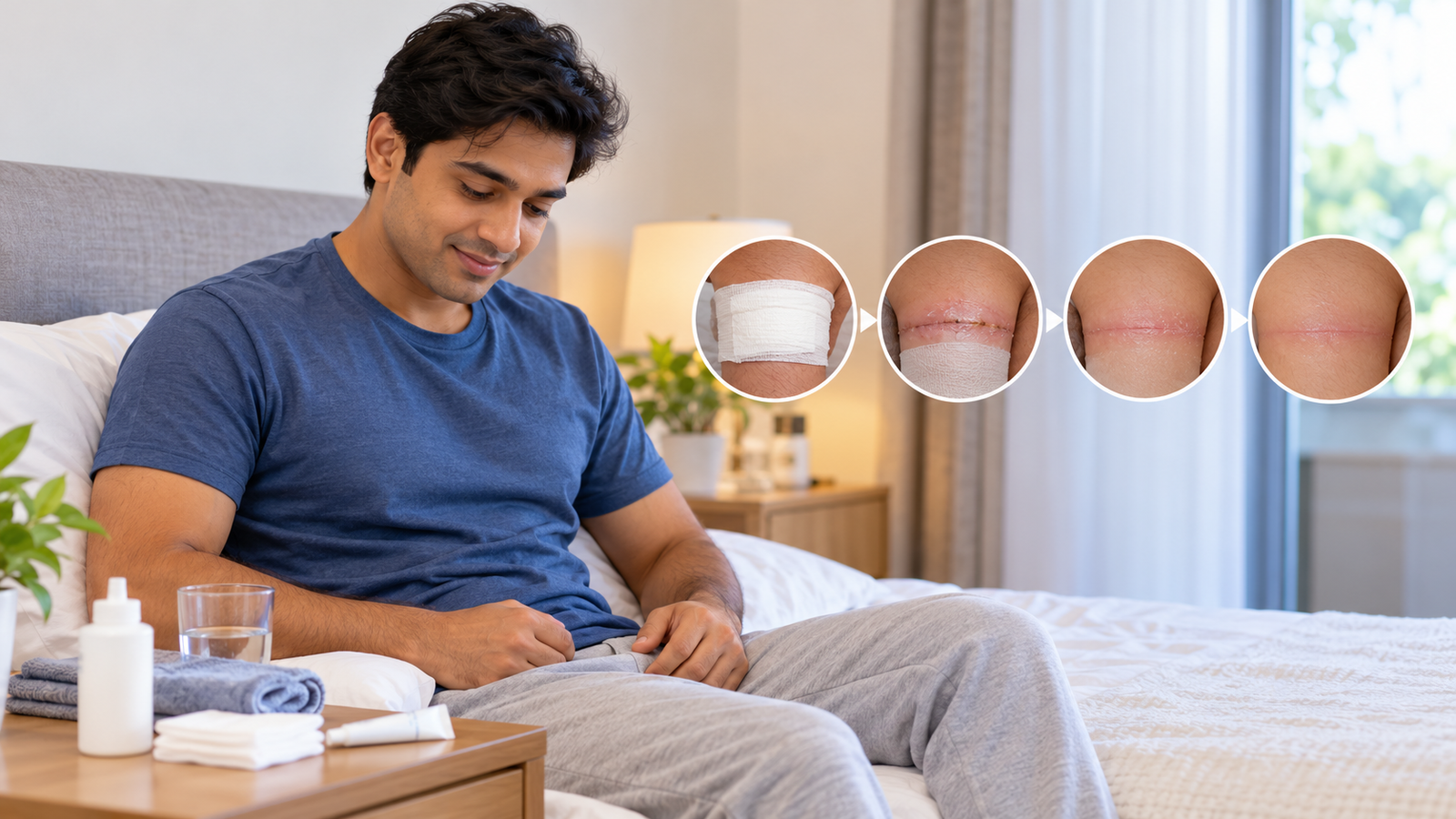
Circumcision Healing Time: Day by Day
The following timeline describes common changes after adult circumcision.
| Recovery Period | Expected Healing Changes | Recommended Care |
|---|---|---|
| Day 1 | Tenderness, mild swelling, and possible spotting | Rest and follow dressing instructions |
| Days 2–3 | Swelling, bruising and sensitivity may increase | Gentle hygiene and prescribed medication |
| Days 4–7 | Discomfort often improves; wound remains sensitive | Avoid friction and strenuous activity |
| Days 8–14 | Swelling gradually decreases; wound edges continue healing | Continue wound care and monitor stitches |
| Weeks 3–4 | Less tenderness; some stitches may remain | Increase activity only when appropriate |
| Weeks 4–6 | Many adults achieve substantial wound healing | Resume restricted activities only when cleared |
| After 6 weeks | Scar appearance and sensitivity continue changing | Seek review for persistent problems |
This is a general guide. The appearance and speed of healing vary between individuals.
Day 1: Immediately After Circumcision
During the first 24 hours, the surgical area may remain numb for some time because of local anaesthesia.
As the anaesthetic wears off, patients may notice:
-
Mild to moderate discomfort
-
Tenderness around the incision
-
Slight swelling
-
Small spots of blood on the dressing
-
Increased sensitivity
Rest and take pain medication according to the surgeon's instructions.
Avoid unnecessary movement or pressure around the wound.
If you are concerned about discomfort, read Is Circumcision Painful? What Adults Can Expect.
Days 2–3: Swelling and Sensitivity
Swelling may become more noticeable during the second or third day.
Mild bruising can also appear.
Some patients experience discomfort when walking or when clothing touches the surgical area.
These symptoms are often part of normal early healing.
However, swelling should not increase rapidly or be accompanied by severe pain, fever, or significant bleeding.
Follow the prescribed dressing and cleaning instructions.
Days 4–7: Early Wound Healing
By the end of the first week, many patients notice that discomfort is beginning to improve.
Swelling may start decreasing, although the incision can remain tender.
The wound edges gradually begin forming a stronger connection.
Patients should continue avoiding:
-
Running
-
Cycling
-
Heavy lifting
-
Contact sports
-
Sexual activity
-
Activities that stretch or rub the wound
Do not remove stitches or pull away attached dressings.
Days 8–14: Improving Comfort
During the second week, many patients experience less swelling and tenderness.
The incision may appear drier, and some absorbable stitches may begin loosening.
However, the wound is still healing.
Mild puffiness or firmness around the incision can remain.
Patients should avoid assuming that the absence of pain means they can resume every activity.
If swelling becomes more pronounced rather than improving, read Swelling After Circumcision: What Is Normal?.
Weeks 3–4: Continued Tissue Repair
During the third and fourth weeks, the wound generally becomes more comfortable.
Some patients may notice:
-
Reduced sensitivity
-
Less swelling
-
A firmer incision line
-
Remaining absorbable stitches
-
Mild discomfort during erections
The scar may still appear pink or slightly raised.
These changes can be part of normal scar maturation.
Patients should continue following activity restrictions until their surgeon confirms that healing is adequate.
Weeks 4–6: Substantial Wound Healing
Many adults achieve substantial wound healing within approximately four to six weeks.
By this stage, most early swelling and discomfort should have improved considerably.
However, recovery is not identical for everyone.
Some patients may still experience residual tenderness, sensitivity, or firmness.
Sexual activity should resume only after adequate healing has been confirmed.
After Six Weeks: Scar Maturation
Even after the wound has healed, the scar can continue changing.
It may gradually become softer and less noticeable over several months.
Some residual sensitivity may also improve with time.
Persistent pain, new swelling, discharge, or an unusual lump should be assessed by the surgeon.
What Are the Different Circumcision Recovery Stages?
Healing is a continuous process, but it can be understood in three overlapping stages.
Stage 1: Inflammation
During the first several days, the body responds to surgery by increasing blood flow and sending inflammatory cells to the wound.
This can cause swelling, redness, and tenderness.
Mild inflammation is expected, but progressively worsening symptoms may indicate a complication.
Stage 2: Wound Repair
Over the following days and weeks, new tissue forms and the wound edges become more securely connected.
Discomfort and swelling generally decrease.
However, the developing tissue remains vulnerable to friction and excessive stretching.
Stage 3: Scar Maturation
Once the wound has closed, the scar continues to remodel.
Firmness, colour and sensitivity can change over several months.
The final scar appearance cannot reliably be judged during the first few weeks.
How Should You Care for a Circumcision Wound?
Appropriate circumcision wound care helps protect the incision and supports recovery.
1. Follow Dressing Instructions
The surgeon may apply a dressing after the procedure.
Follow the instructions about when it should be removed or changed.
If a dressing becomes stuck, do not pull it away forcefully.
Contact the treating team for guidance.
2. Keep the Area Clean
Clean the wound only as instructed.
The surgeon will explain when showering is appropriate and whether any particular cleaning method is recommended.
Avoid harsh soaps and unnecessary rubbing.
3. Avoid Unprescribed Products
Do not apply powders, household antiseptics, herbal preparations, or medicated creams unless advised.
Some products may irritate healing tissue.
4. Wear Comfortable Underwear
Soft, supportive underwear may help reduce movement and friction.
Choose clothing that does not create painful pressure.
5. Take Medication Correctly
Use prescribed pain relief and other medications according to instructions.
Do not increase doses or start additional medicines without medical advice.
6. Protect the Wound From Friction
Avoid activities that repeatedly rub, stretch, or compress the incision.
The surgeon can advise when different activities may be resumed.
When Do Circumcision Stitches Dissolve?
Many adult circumcision procedures use absorbable stitches.
These stitches are designed to break down gradually as healing progresses.
Some may loosen or fall away within a few weeks, while others take longer.
The exact timing depends on the suture material and individual healing.
Should You Remove Circumcision Stitches Yourself?
No.
Do not pull, cut, or remove stitches unless specifically instructed by your surgeon.
Removing them prematurely may disturb the wound.
What if a Stitch Remains After Several Weeks?
A remaining stitch does not automatically indicate a complication.
However, patients should contact the surgeon if a stitch causes persistent irritation, appears embedded, or is associated with increasing redness or discharge.
The clinician can determine whether any intervention is necessary.
When Can You Walk, Work, Exercise and Have Sex?
The appropriate return-to-activity timeline depends on wound healing and the surgeon's instructions.
| Activity | General Recovery Guidance |
|---|---|
| Gentle walking | Often possible early, as comfort allows |
| Desk-based work | May be possible after several days |
| Physically demanding work | May require additional recovery time |
| Running and gym workouts | Resume gradually after medical clearance |
| Cycling and contact sports | Avoid until pressure and friction are safe |
| Sexual intercourse | Commonly restricted for around 4–6 weeks |
| Masturbation | Avoid until adequate healing is confirmed |
Returning to Work
Patients with office-based jobs may return earlier than those who perform heavy lifting or physical labour.
A return-to-work plan should consider discomfort, mobility and the wound condition.
Exercise and Sports
Strenuous exercise can increase friction and pressure around the incision.
Do not restart intense exercise simply because pain has improved.
Sexual Activity
Intercourse and masturbation can place tension on healing tissue.
Many adult postoperative instructions recommend avoiding sexual activity for approximately four to six weeks.
The final decision should depend on adequate healing and the surgeon's advice.
Does Healing Time Differ Between Circumcision Methods?
Different circumcision techniques may involve different instruments and wound-closure methods.
However, all techniques require tissue healing.
Conventional Circumcision
Conventional circumcision involves surgically removing the foreskin and commonly closing the incision with absorbable stitches.
Temporary swelling and tenderness are expected.
Laser Circumcision
Laser circumcision uses laser energy to cut tissue.
Although the technique may differ in bleeding control and tissue handling, it does not eliminate the need for postoperative healing.
Stapler Circumcision
Stapler circumcision uses a specialised device to remove the foreskin and assist wound closure.
Patients may require specific instructions regarding the closure line and retained staples.
Which Method Heals Fastest?
Recovery comparisons vary according to surgical technique, patient characteristics, and the definition of healing used.
No technique guarantees the fastest recovery for every adult.
Patients should choose a procedure based on medical suitability rather than recovery-time claims alone.
What Can Delay Circumcision Healing?
Several factors can affect wound healing.
Diabetes
Poor blood sugar control can interfere with healing and increase infection risk.
Patients with diabetes should discuss perioperative management with their healthcare team.
Smoking and Nicotine
Smoking and nicotine exposure can affect circulation and tissue repair.
Patients should discuss cessation before and after surgery.
Wound Infection
An infection may cause increasing pain, redness, swelling, or discharge.
Prompt treatment is important.
Excessive Physical Activity
Heavy exercise or friction can place unnecessary stress on the healing incision.
Poor Wound Care
Using irritating products, removing dressings incorrectly, or ignoring postoperative instructions can interfere with recovery.
Patients should follow their surgeon's individual care plan.
What Are the Warning Signs During Circumcision Recovery?
Some swelling, tenderness, and bruising are expected.
However, certain symptoms require medical attention.
Contact your surgeon promptly if you notice:
-
Increasing pain instead of gradual improvement
-
Spreading redness or warmth
-
Fever
-
Pus or foul-smelling discharge
-
Wound separation
-
Significant or increasing swelling
-
Persistent bleeding
-
Unusual skin discoloration
-
A wound that is not healing as expected
Seek emergency medical care for uncontrolled bleeding, inability to pass urine, or rapidly worsening severe symptoms.
Do not wait for a scheduled follow-up if a serious warning sign develops.
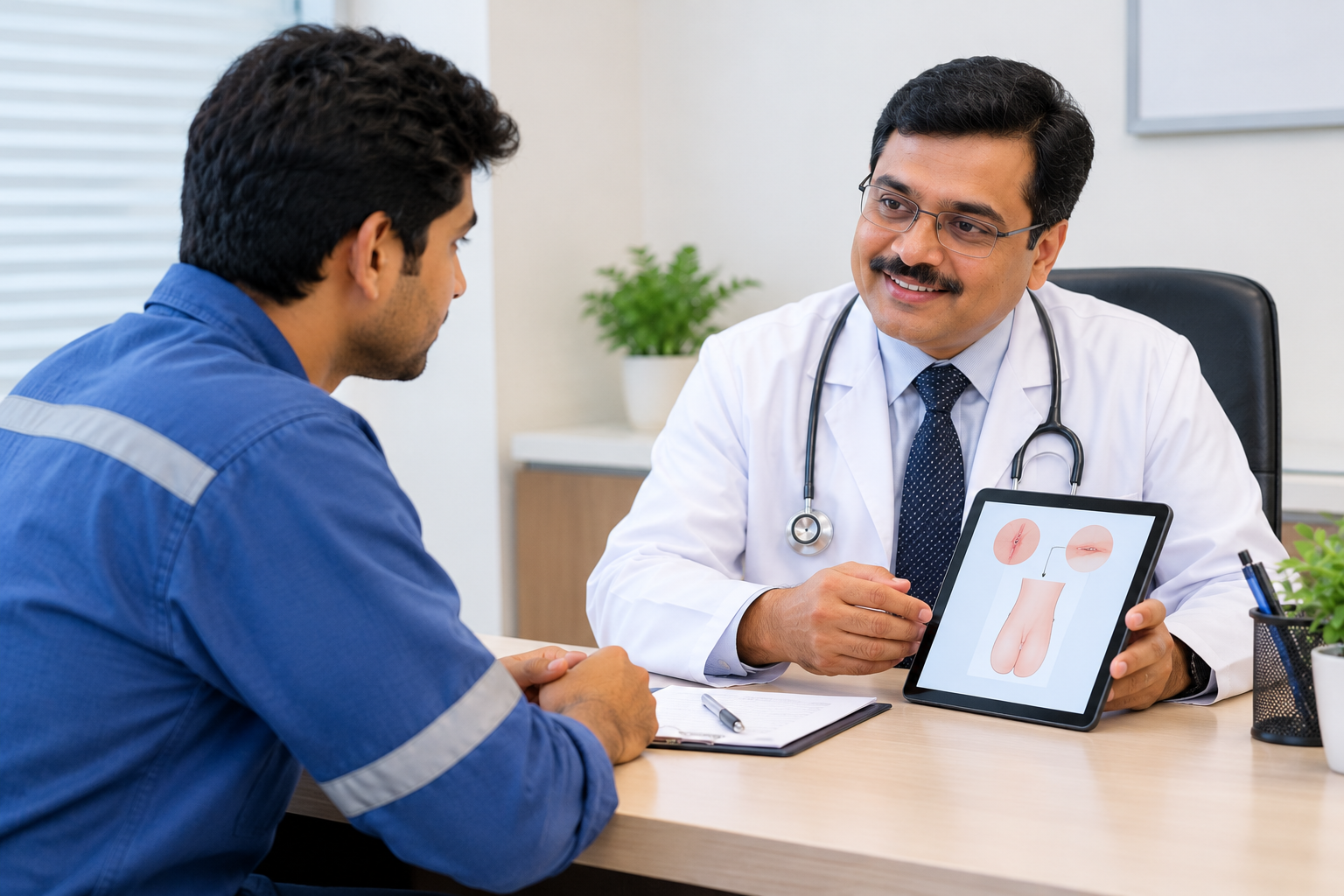
Circumcision Healing and Follow-Up With Dr. Ashutosh Shah
At Elegance Clinic, patients consulting Dr. Ashutosh Shah, a Plastic, Reconstructive & Cosmetic Surgeon with over 22 years of surgical experience, can discuss expected healing stages, wound care, activity restrictions, and postoperative concerns. Recovery guidance should be individualised according to the surgical method, medical history, and wound condition.
Patients should attend recommended follow-up appointments and report symptoms that do not follow the expected recovery pattern.
For individual guidance, patients can book a circumcision consultation.
Conclusion: Understanding Circumcision Healing Time
Circumcision healing time varies, but many adults achieve substantial wound healing within approximately four to six weeks.
The first few days commonly involve swelling, tenderness, and increased sensitivity.
Discomfort generally improves during the first week, while wound closure and tissue repair continue over the following weeks.
Absorbable stitches may take several weeks to dissolve, and the scar can continue changing for months.
Good wound care, appropriate activity restrictions, and follow-up appointments help support recovery.
The most important point is that reduced pain does not always mean complete healing. Follow your surgeon's instructions and seek medical assessment if symptoms become worse rather than better.