Is Advanced Circumcision Less Painful Than Traditional Circumcision?
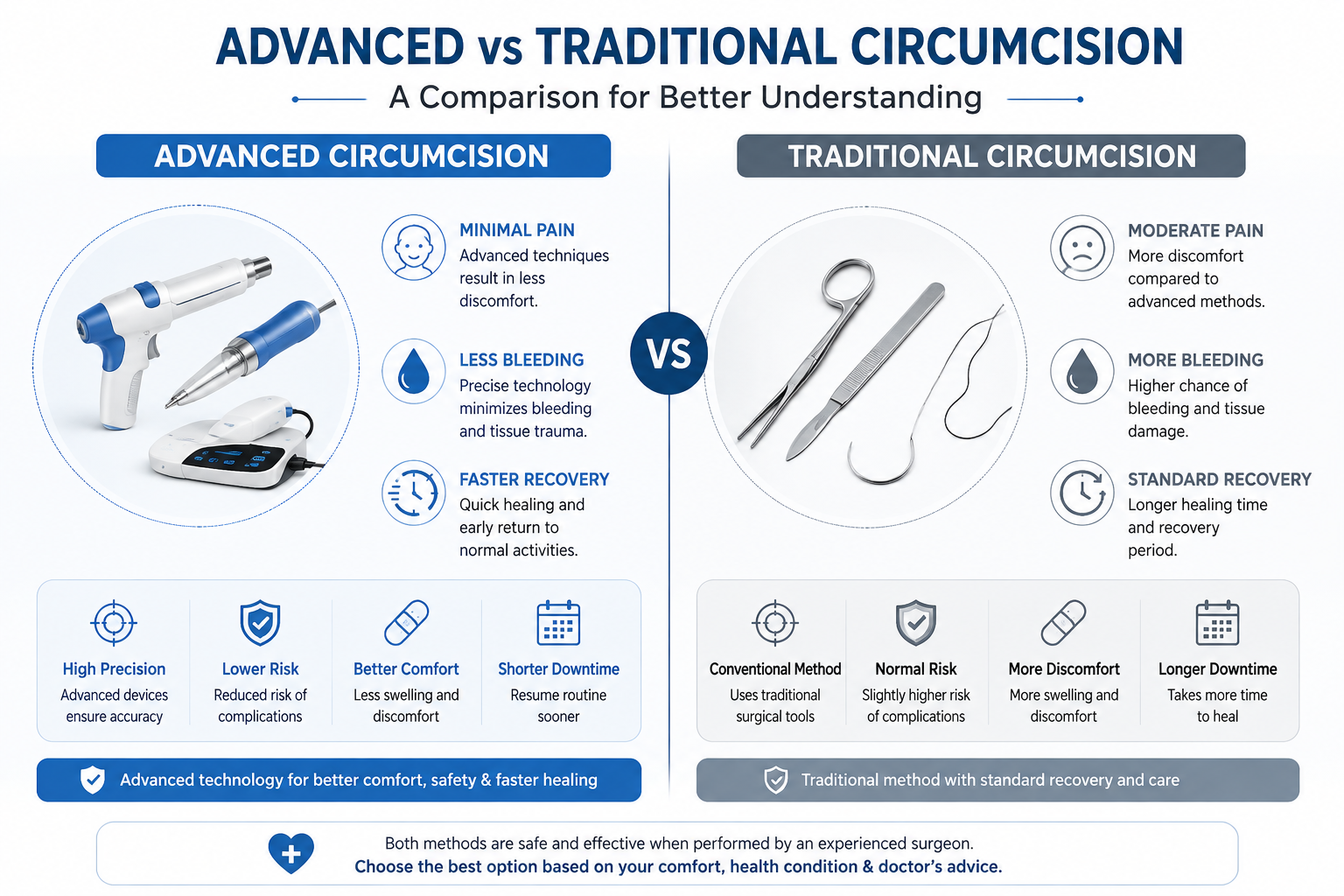
Yes, many modern ("advanced") circumcision techniques are associated with less pain and a more comfortable recovery than traditional circumcision, but the difference is generally modest rather than dramatic. The biggest factors affecting pain are the quality of anesthesia, the surgeon's experience, and how well you follow postoperative care instructions.
What is traditional circumcision?
Traditional circumcision is the conventional surgical method where the surgeon:
- Marks and removes the foreskin using a scalpel or surgical scissors.
- Controls bleeding with electrocautery or sutures.
- Closes the wound with dissolvable stitches.
Advantages
- Well-established and widely available.
- Suitable for almost all medical conditions.
- Gives the surgeon precise control over the amount of skin removed.
Disadvantages
- More tissue handling can lead to greater swelling.
- Usually requires stitches.
- Recovery discomfort may be somewhat greater during the first week.
What is "advanced circumcision"?
The term "advanced circumcision" is a marketing term rather than a medical one. It may refer to:
- Stapler circumcision
- Disposable circumcision devices
- Laser-assisted circumcision (although the laser usually only replaces the cutting instrument)
- Radiofrequency or electrosurgical techniques
- Glue-assisted wound closure instead of stitches in selected cases
Different hospitals use different names.
Pain comparison
During the procedure
Traditional surgery
- Local anesthesia blocks pain.
- You may feel pressure or pulling but should not feel sharp pain.
Advanced techniques
- Also performed under local anesthesia.
- Pain during the procedure is generally the same because the anesthesia, not the device, prevents pain.
Immediately after surgery (first 24–48 hours)
Traditional:
- Mild to moderate pain
- More swelling
- Slightly higher chance of bruising
Advanced:
- Often less swelling
- Less bleeding
- Many patients report milder discomfort
Pain scores from studies generally show only a small to moderate reduction in pain with some device-assisted methods.
First week
Traditional:
- Pain gradually improves.
- Stitches may become uncomfortable.
- Erections can temporarily increase discomfort.
Advanced:
- Often less irritation from sutures (if fewer or no stitches are used).
- Wound edges may remain more stable.
- Many people return to light daily activities a little sooner.
Long-term
After healing (usually 4–8 weeks in adults), there is no meaningful difference in pain between techniques.
Why advanced methods may hurt less
Several factors can reduce postoperative discomfort:
1. Less tissue trauma
Some devices compress tissue before cutting, reducing injury to surrounding areas.
2. Better bleeding control
Less bleeding means:
- Less bruising
- Less swelling
- Less inflammation
3. Reduced need for stitches
Stitches can:
- Pull on the skin
- Cause irritation
- Increase discomfort during erections
Some advanced methods use fewer stitches or tissue adhesive.
4. Shorter operation
Many advanced procedures take 5–15 minutes, while traditional surgery often takes 20–40 minutes.
A shorter procedure can reduce tissue exposure and manipulation.
Does laser circumcision hurt less?
Not necessarily.
This is a common misconception.
A laser mainly replaces the scalpel as the cutting tool.
Studies generally show:
- Similar pain levels
- Similar healing time
- Slightly less bleeding in some cases
The laser itself is not the primary reason for less pain.
Recovery comparison
| Recovery factor | Traditional | Advanced |
|---|---|---|
| Operation time | 20–40 min | 5–15 min (often) |
| Bleeding | Low | Often lower |
| Swelling | Moderate | Often less |
| Stitches | Usually required | Sometimes fewer or none |
| First-week pain | Mild to moderate | Mild to moderate, often slightly less |
| Return to work | 3–7 days | 2–5 days (varies) |
| Complete healing | 4–8 weeks | 4–8 weeks |
What does the research say?
Research comparing device-assisted and conventional circumcision generally finds that newer techniques can offer:
- Shorter operative times.
- Less blood loss.
- Reduced early postoperative pain in some studies.
- Faster return to routine activities.
However, overall healing time and long-term cosmetic results are often similar when procedures are performed well.
Factors that affect pain more than the technique
The following often have a greater impact than whether the procedure is labeled "advanced":
- The surgeon's experience: Careful surgical technique can reduce tissue trauma and complications.
- Anesthesia: A well-performed local anesthetic block significantly improves comfort during surgery.
- Postoperative care: Keeping the area clean, wearing supportive underwear, and following wound-care instructions can reduce discomfort.
- Individual pain sensitivity: People vary widely in how they experience pain.
Possible complications (both methods)
Although uncommon, both approaches carry risks such as:
- Bleeding
- Infection
- Swelling
- Wound separation
- Delayed healing
- Unsatisfactory cosmetic result
- Need for revision surgery (rare)
No circumcision method eliminates these risks.
Which method should you choose?
A newer device-assisted technique may be a good option if:
- You want a shorter procedure.
- You prefer potentially less bleeding and swelling.
- It is offered by an experienced surgeon.
Traditional surgical circumcision may be preferable if:
- You have significant phimosis, scarring, or anatomical variations.
- Your surgeon recommends it based on your condition.
- Device-assisted techniques are not suitable or available.
Decision
For most adults, advanced circumcision techniques can reduce early postoperative pain, swelling, and bleeding compared with traditional circumcision, but the improvement is usually moderate rather than dramatic. During the procedure, pain is minimal with either method because of local anesthesia. In the long term, healing, function, and outcomes are generally similar when the procedure is performed by an experienced clinician. The choice of an experienced urologist and appropriate postoperative care often has a greater influence on comfort and recovery than the specific technique used.
About the Medical Reviewer
Dr. Ashutosh Shah is a board-certified Plastic, Reconstructive, and Cosmetic Surgeon and Director of Elegance Clinic, Surat. With more than 25 years of surgical experience and over 15,000 procedures performed, he specializes in advanced cosmetic, reconstructive, and genital surgical procedures, including modern circumcision techniques.