Hypospadias in a Baby Boy: Why Circumcision Must Wait and When Repair Is Planned
Hypospadias is a condition present at birth in which the urine opening lies on the underside of the penis instead of at the tip. Parents should avoid circumcision if doctors suspect hypospadias because surgeons may need the foreskin for reconstruction. Specialists commonly plan hypospadias surgery between 6 and 18 months of age, depending on the child's anatomy and health.
When parents notice an unusual foreskin shape or urine opening in their newborn, they may worry about whether their baby needs immediate surgery. In most cases, hypospadias does not require emergency repair, but the baby should undergo a specialist examination before any circumcision.
Some children have a mild difference near the tip of the penis. Others have an opening farther down, penile curvature, or additional anatomical differences.
Understanding the condition helps parents protect tissue that may be important for future reconstruction and choose the appropriate time for treatment.
What Is Hypospadias and How Is It Noticed at Birth?
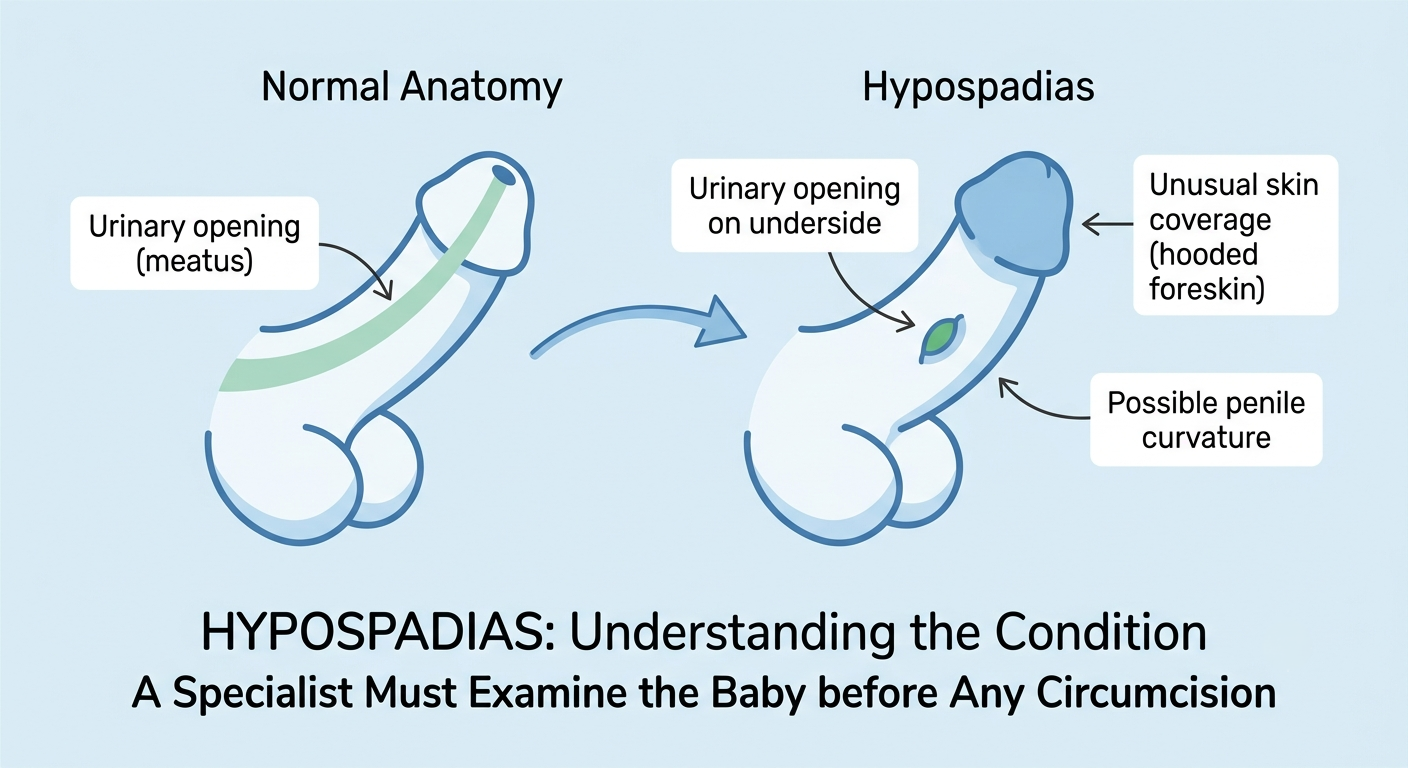
Hypospadias is a congenital condition that affects the position of the urethral opening, also called the urinary meatus.
Normally, the urethral opening sits at the tip of the penis. In a child with hypospadias, the opening appears somewhere along the underside.
The condition may also affect foreskin development and penile curvature.
Parents or healthcare professionals may notice several signs during the newborn examination.
Common Signs of Hypospadias
Urine opening below the tip: The opening may appear just beneath the tip, along the penile shaft, or closer to the base.
Hooded foreskin: The foreskin may cover the upper part of the glans while leaving less skin underneath.
Downward curvature: Some babies have a downward bend called chordee. The degree of curvature varies.
Unusual urine stream: The urine may flow downward or spray instead of moving forward.
Different penile appearance: The glans and foreskin may appear different from what parents expect.
Not every baby with an unusual foreskin has hypospadias. A specialist must examine the anatomy to confirm the diagnosis.
Parents can read more about why a baby's penis may look different to understand common developmental variations.
Parent Checklist: Signs to Check at Birth
| What Parents Notice | What It May Mean |
|---|---|
| Urine opening below the tip | Possible hypospadias |
| Foreskin covering mainly the upper surface | Hooded foreskin |
| Penis curving downward | Possible chordee |
| Urine flowing downward or spraying | Altered urine stream |
| Baby struggling to pass urine | Needs prompt medical assessment |
| Unusual penile appearance | Requires examination before circumcision |
Parents should not pull back a newborn's foreskin forcefully to examine the opening.
If the baby cannot pass urine, develops marked swelling, or appears unwell, seek urgent medical care.
Why Should a Baby With Hypospadias Not Be Circumcised?
The most important rule is simple: Do not perform routine circumcision before a specialist evaluates suspected hypospadias.
Circumcision removes the foreskin, but surgeons sometimes use foreskin tissue during hypospadias reconstruction.
The tissue may help create or support the reconstructed urethra, cover the repair, or provide healthy skin where the penis lacks sufficient tissue.
Removing the foreskin before evaluation may reduce the available reconstructive options.
Why Is the Foreskin Important?
During hypospadias repair, the surgeon may need additional tissue to reconstruct the urinary passage or cover the surgical area.
The foreskin can provide tissue with a useful blood supply and suitable characteristics for selected repairs.
However, not every hypospadias operation requires foreskin tissue. Some techniques use local urethral tissue or other available tissues.
The specialist decides whether the foreskin is necessary after examining the child's anatomy.
What Should Parents Do Before Circumcision?
Parents should inform the doctor if they notice a hooded foreskin, unusual urine opening, or penile curvature.
They should postpone circumcision until a paediatric urologist or appropriately experienced reconstructive surgeon completes the assessment.
The American Academy of Pediatrics Task Force on Circumcision identified hypospadias as a condition that requires caution before newborn circumcision.
Parents considering paediatric circumcision should ensure that the doctor examines the urinary opening and penile anatomy first.
At What Age Is Hypospadias Surgery Usually Done?
Specialists commonly recommend hypospadias surgery between 6 and 18 months of age when repair is necessary.
This timing allows surgeons to treat the condition during early childhood while considering anaesthesia safety, tissue development, and recovery.
However, the exact age depends on the type of hypospadias, the child's general health and the surgeon's assessment.
Some babies need additional investigations or treatment before reconstruction.
Why Do Surgeons Often Recommend Early Repair?
Early repair may help correct penile curvature, position the urinary opening more appropriately and support future urinary function.
Younger children may also have fewer memories of the procedure.
However, parents should understand that early surgery still involves anaesthesia, wound care and possible complications.
The surgeon should explain the benefits and risks of the proposed timing.
Can Parents Wait Until the Child Is Older?
Some families seek treatment later because doctors did not identify the condition at birth or because they postponed consultation.
Surgeons can perform hypospadias repair in older children, but the treatment plan may differ.
Parents should not delay specialist assessment simply because the child passes urine normally.
An early consultation helps determine whether surgery is necessary and when to schedule it.
The right age for circumcision is a separate question. Hypospadias takes priority over routine circumcision planning.
What Does Hypospadias Repair Involve and How Many Stages Are Needed?
Child hypospadias repair aims to improve the position and function of the urinary opening and correct significant penile curvature when present.
The surgeon examines the position of the opening, tissue quality, glans shape, and degree of curvature.
The operation may involve straightening the penis, reconstructing part of the urethra and covering the repaired area with healthy tissue.
Surgeons commonly use general anaesthesia for children undergoing repair.
Some children also need a temporary urinary catheter or stent to protect the reconstruction while it heals.
Types of Hypospadias and Surgical Planning
| Type | Position of Urine Opening | Typical Surgical Approach | Possible Foreskin Use | Usual Timing |
|---|---|---|---|---|
| Distal hypospadias | Near the tip | Often one stage | May not be necessary | Commonly 6 to 18 months |
| Midshaft hypospadias | Along the middle of the underside | Often one stage, depending on curvature | May help with tissue coverage | Commonly 6 to 18 months |
| Proximal hypospadias | Near the base or farther back | One or more stages depending on anatomy | May provide important reconstructive tissue | Individual specialist plan |
The location of the opening alone does not determine the number of operations.
Significant curvature, insufficient tissue, previous surgery, and other anatomical findings may require a more complex approach.
What Happens During a One-Stage Repair?
In a one-stage procedure, the surgeon aims to complete the planned reconstruction during a single operation.
The surgeon may straighten the penis, reconstruct the urethral passage, and reposition the urinary opening.
A temporary catheter may help urine drain while the wound heals.
When Does a Child Need Two Stages?
Some children with severe curvature or limited healthy tissue need staged reconstruction.
During the first operation, the surgeon may correct curvature and prepare tissue for later urethral reconstruction.
The second operation usually takes place after the tissues have healed sufficiently.
The surgeon explains the expected interval and the possibility of additional procedures.
Hypospadias Surgeon Gujarat: What Should Parents Ask Before Treatment?
Parents should choose a surgeon with appropriate training and experience in paediatric hypospadias reconstruction.
The consultation should focus on the child's anatomy, the need for surgery, and the safest treatment plan.
At Elegance Clinic, Dr. Ashutosh Shah, a Plastic, Reconstructive & Cosmetic Surgeon with over 22 years of surgical experience, can assess reconstructive concerns and help families understand the importance of preserving the foreskin when hypospadias is suspected. Parents should confirm the availability of specialist paediatric hypospadias repair and the appropriate referral pathway before scheduling treatment.
During consultation, parents should ask whether the child has distal, midshaft or proximal hypospadias, whether penile curvature is present and whether the surgeon expects one or more operations.
They should also discuss the possible need for foreskin tissue, anaesthesia, catheter care, follow-up appointments and complications.
An experienced specialist should explain why a particular technique suits the child's anatomy rather than promising identical outcomes for every patient.
What Complications Should Parents Watch for After Hypospadias Repair?
Most children recover with appropriate postoperative care, but hypospadias reconstruction can cause complications.
Parents should understand which symptoms are expected and which require medical attention.
Urethrocutaneous Fistula
A fistula is an unwanted opening between the reconstructed urethra and the skin.
Parents may notice urine leaking from a second opening.
Some fistulas require another operation after the tissues heal.
Narrowing of the Urine Opening
Scar tissue may narrow the urinary opening or reconstructed urethra.
The child may develop a weak urine stream, straining, or difficulty passing urine.
A specialist should assess these symptoms promptly.
Wound Separation
The repaired tissues may separate during healing.
The surgeon must examine the wound to determine whether observation, wound care or further treatment is necessary.
Infection or Bleeding
Some swelling and mild spotting may occur after surgery.
However, increasing redness, fever, pus, persistent bleeding, or worsening pain requires medical assessment.
Recurrent Penile Curvature
In some children, curvature may persist or become more noticeable as they grow.
The surgeon may recommend further evaluation or corrective treatment.
When Should Parents Seek Urgent Help?
Parents should contact the surgical team urgently if the child cannot pass urine, the catheter stops draining, bleeding becomes significant, or the child develops fever with worsening pain or swelling.
Follow the surgeon's specific catheter and wound care instructions. Do not remove a catheter or dressing unless the surgical team advises it.
Does Every Baby With Hypospadias Need Surgery?
Not every child with hypospadias requires immediate or automatic surgical correction.
Some boys have very mild distal hypospadias, minimal curvature, and an acceptable urinary stream.
A specialist may discuss observation when the condition does not cause meaningful functional problems.
However, other children need repair because the opening position or curvature may interfere with urinary function or future sexual function.
The decision should consider anatomy, expected function, possible benefits, and surgical risks.
Parents should also understand when circumcision is indicated, because hypospadias changes the usual decision about foreskin removal.
What Determines Hypospadias Surgery Cost?
Hypospadias surgery cost varies according to the severity of the condition, the planned reconstruction and the number of stages.
A mild distal repair may require a different operation from a complex proximal reconstruction.
Other cost factors include surgeon's fees, anaesthesia, hospital facilities, admission, catheter care and follow-up appointments.
Parents should request a written estimate that explains the expected procedure, hospital charges and potential additional costs.
The surgeon should also discuss the possibility of revision surgery if complications develop.
Cost alone should not determine the choice of surgeon or technique. Experience with paediatric reconstruction and appropriate postoperative support are important considerations.
Conclusion: Why Hypospadias Must Be Checked Before Circumcision
Hypospadias surgery helps correct selected congenital differences involving the urinary opening, urethra, and penile curvature.
The most important message for parents is to avoid routine circumcision when they suspect hypospadias.
The foreskin may provide valuable tissue for reconstruction, and removing it before specialist evaluation can limit some surgical options.
Many children who need repair undergo surgery between 6 and 18 months of age, although the timing and technique depend on individual findings.
Parents should seek an appropriate specialist assessment, understand the expected treatment stages, and follow the recommended postoperative care plan.
Early evaluation helps families make informed decisions while preserving the options their child may need for future reconstruction.