Is Circumcision Covered by Mediclaim? Medical Indication, Documents and Day-Care Claims
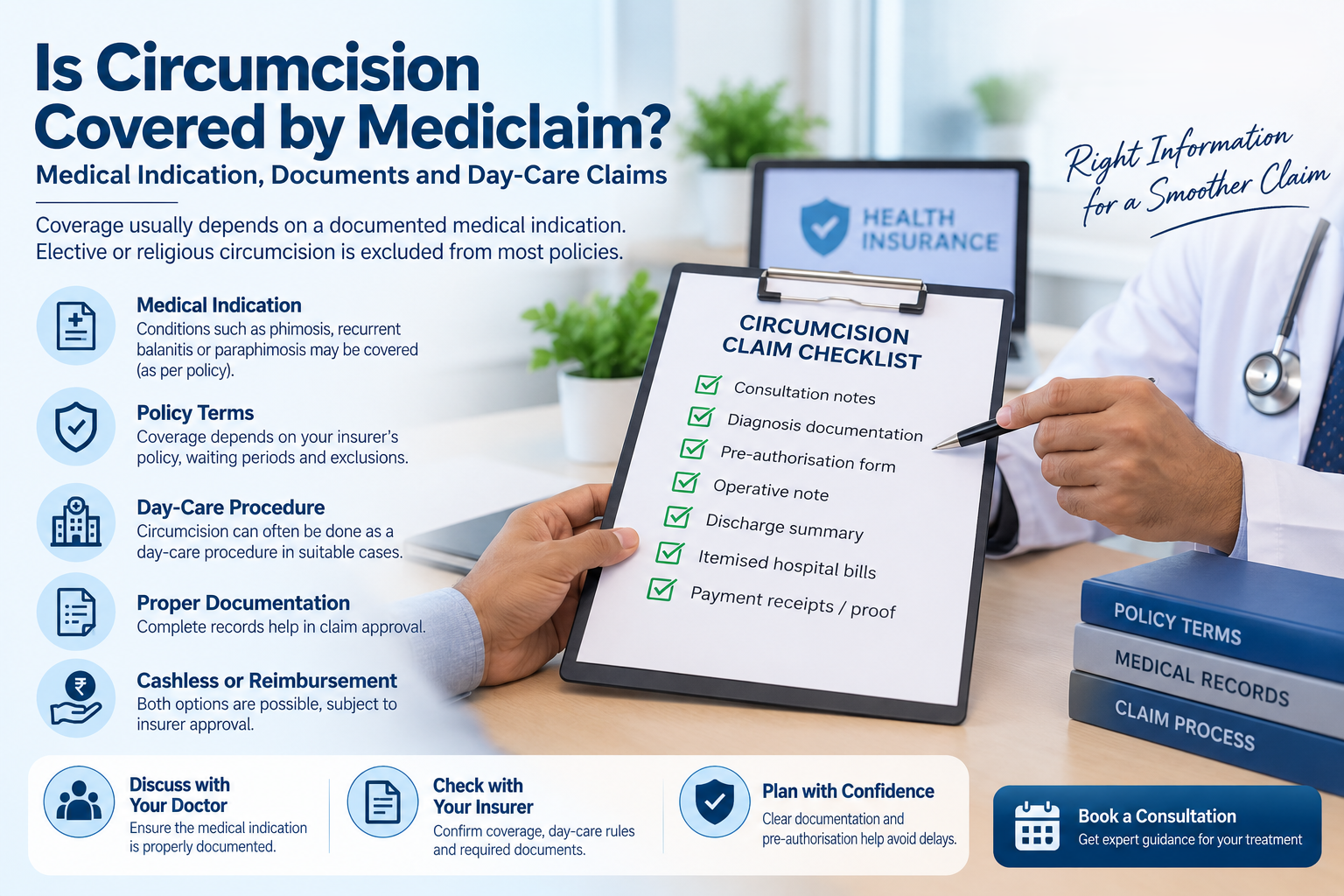
Mediclaim policies in India generally cover circumcision only when there is a documented medical indication such as phimosis, paraphimosis, or recurrent balanitis; elective or religious circumcision is excluded from almost every policy.
However, a medical diagnosis does not automatically guarantee approval. Whether circumcision is covered by mediclaim depends on the wording of the individual insurance policy, medical necessity, exclusions, waiting periods, hospital eligibility, documentation, and the insurer or third-party administrator's claim decision.
Patients considering circumcision at Elegance Clinic, Surat, can discuss the medical indication and treatment plan with Dr. Ashutosh Shah, a plastic surgeon with 22+ years of experience. For insurance-related treatment, patients should also confirm coverage directly with their insurer or TPA before the procedure whenever possible.
Why Do Insurers Separate Medically Indicated From Elective Circumcision?
Health insurance is primarily designed to pay for eligible medical treatment rather than procedures performed solely because of personal, cultural, cosmetic, or religious preference.
This distinction becomes particularly important with circumcision because the same operation can be performed for very different reasons.
One patient may undergo circumcision because a scarred foreskin causes persistent phimosis and repeated infections. Another may choose the operation without a medical condition.
From an insurance perspective, these are not necessarily treated in the same way.
A claim is more likely to require evidence that the procedure was recommended to treat a documented medical problem. Relevant clinical information may include the patient's symptoms, examination findings, diagnosis, previous treatment, and the reason surgery became necessary.
Patients can review common medical Indications for circumcision before discussing treatment.
Which Diagnoses Commonly Support a Claim?
Medical conditions that can lead a doctor to recommend circumcision include phimosis, recurrent balanitis or balanoposthitis, paraphimosis, and certain foreskin problems associated with significant scarring or repeated symptoms.
However, the presence of one of these diagnoses does not mean an insurance claim will automatically be approved.
Phimosis
Phimosis is a condition in which the foreskin cannot be comfortably retracted.
Not every case requires surgery. Depending on the cause and severity, conservative treatment may sometimes be attempted first.
When clinically significant phimosis persists, causes functional problems, or is associated with substantial scarring, circumcision may be recommended.
For someone researching insurance for phimosis surgery, the important point is that the diagnosis and reason for surgery should be clearly documented in the medical record.
Recurrent Balanitis or Balanoposthitis
Repeated inflammation or infection involving the glans and foreskin may become an indication for circumcision when episodes continue despite appropriate treatment.
Records of repeated episodes and previous treatment can help establish why surgery was recommended.
Paraphimosis
Paraphimosis occurs when a retracted foreskin becomes trapped behind the glans and cannot return to its normal position. It can become an urgent medical problem.
The immediate problem may require urgent treatment, while subsequent management depends on the individual case.
Significant Foreskin Scarring
Persistent scarring can produce a tight, non-elastic foreskin and make conservative treatment less effective.
The medical notes should describe the actual clinical findings rather than relying on a general statement that circumcision is required.
How Do Day-Care Procedure Rules Apply to Circumcision?
A common misconception is that a patient must remain in hospital overnight before health insurance can apply.
Modern insurance policies may recognise eligible day-care procedures that do not require a traditional 24-hour hospital admission because advances in anaesthesia and surgery allow earlier discharge.
Circumcision can often be performed as a day-care procedure in suitable patients.
A patient may:
- Arrive at the facility on the scheduled day.
- Complete admission and preoperative preparation.
- Undergo the planned procedure.
- Remain under observation during recovery.
- Be discharged the same day if medically fit.
Whether a day care procedure insurance claim is payable depends on the specific policy and claim conditions.
Same-day discharge should therefore not automatically be interpreted as either "covered" or "not covered."
Patients can read more about Day-care circumcision explained.
Which Documents Must Be Collected Before and After the Procedure?
Documentation is one of the most important parts of an insurance claim.
The insurer needs enough information to establish what condition was diagnosed, why surgery was advised, what treatment was performed, and how much was charged.
Circumcision Mediclaim Document Checklist
| Document | Why it may be required |
|---|---|
| Consultation notes | Record symptoms, examination and treatment recommendation |
| Diagnosis documentation | Establishes the medical reason for surgery |
| Investigation reports | Supports preoperative assessment where applicable |
| Pre-authorisation form | Used when seeking cashless approval |
| Insurer/TPA approval | Records the terms of cashless authorisation |
| Operative note | Documents the procedure performed |
| Discharge summary | Records diagnosis, treatment and discharge advice |
| Itemised hospital bill | Shows individual treatment charges |
| Payment receipts | Provides evidence of amounts paid |
| Medicine invoices | May be required for eligible medicine expenses |
| Implant/device invoice if applicable | Documents separately charged devices where relevant |
Patients may also need investigations before surgery depending on age, health and anaesthesia requirements. More information is available under Tests before surgery.
What Should the Consultation Note Contain?
A vague note may make it harder for an insurer to understand why surgery was medically necessary.
Where clinically appropriate, the medical record should accurately document:
- Main symptoms
- Duration of symptoms
- Examination findings
- Diagnosis
- Previous treatment
- Recurrence or failure of conservative treatment, if applicable
- Reason surgery is being advised
- Planned procedure
The purpose is not to change or exaggerate the diagnosis for insurance. Documentation should accurately reflect the patient's actual clinical condition.
How Does Cashless Pre-Authorisation Differ From Reimbursement?
There are two common ways patients may make a health insurance claim: cashless treatment and reimbursement.
Cashless Claim
For a cashless claim, an eligible network hospital or facility generally sends a pre-authorisation request to the insurer or TPA.
The request may include:
- Diagnosis
- Doctor's recommendation
- Proposed procedure
- Expected admission or day-care details
- Estimated treatment cost
- Relevant reports
The insurer or TPA then reviews the request.
It may approve the request, ask for additional information, approve only part of the estimated amount, or decline authorisation according to the policy terms.
Cashless approval should therefore be obtained before assuming that the complete bill will be paid.
Reimbursement Claim
With reimbursement, the patient pays the eligible treatment expenses first and subsequently submits a claim to the insurer.
The insurer then reviews the documentation and decides which expenses are payable under the policy.
This route may require original or accepted copies of:
- Claim form
- Consultation records
- Investigation reports
- Discharge summary
- Operative notes
- Hospital bills
- Payment receipts
- Pharmacy bills
- Other documents requested by the insurer
Patients should check the submission deadline and document requirements stated in their policy.
Can You Claim After Paying for Circumcision Yourself?
Potentially, yes, if the policy allows reimbursement and the treatment qualifies under its terms.
Paying the hospital yourself does not by itself make the procedure eligible or ineligible.
The insurer will still assess issues such as:
- Medical necessity
- Diagnosis
- Waiting periods
- Exclusions
- Hospital eligibility
- Documentation
- Claim submission requirements
For this reason, patients planning reimbursement should contact the insurer before surgery where practical and ask exactly which records must be retained.
Which Exclusions and Waiting Periods Most Often Cause Rejection?
Even medically recommended treatment can face claim problems when policy conditions are not met.
Elective Circumcision
Circumcision performed without a covered medical indication may be excluded.
Personal, cultural, or religious reasons alone generally should not be presented as a medical diagnosis.
Waiting Periods
Some policies impose waiting periods for specified illnesses, procedures, or pre-existing conditions.
If the underlying condition falls within an applicable waiting period, the claim may not be payable yet.
Pre-Existing Condition Rules
If symptoms or a diagnosis existed before the insurance policy began, the insurer may assess the claim according to its pre-existing disease provisions.
Incomplete Documentation
Missing consultation notes, operative records, bills, or discharge documents can delay claim processing or lead to requests for additional information.
Policy Exclusions
Every policy has its own exclusions. Patients should read the current policy wording rather than assuming that another person's successful claim means theirs will also be accepted.
Non-Network Facility Issues
Cashless treatment generally depends on the insurer's network arrangements. A non-network facility may require reimbursement instead, subject to policy conditions.
Does Revision Circumcision Qualify for Mediclaim?
Revision circumcision requires particularly careful documentation.
A revision may be performed for a genuine functional or medical problem, or it may be requested primarily because of dissatisfaction with appearance.
Insurers may treat these circumstances differently.
If revision is medically required, records should clearly document the problem and reason corrective surgery is recommended.
Patients researching the financial side can also read about Revision circumcision cost.
What Should You Confirm With the Insurer Before Surgery?
Before scheduling surgery, ask the insurer or TPA specific questions rather than simply asking, "Is circumcision covered?"
Useful questions include:
- Is treatment for my documented diagnosis covered?
- Does a waiting period apply?
- Is circumcision recognised under the relevant day-care provisions?
- Is the chosen hospital eligible for cashless treatment?
- Is pre-authorisation required?
- Which medical records must be submitted?
- Are surgeon, anaesthesia, and theatre charges covered?
- Are disposable devices subject to separate limits?
- Are medicines and follow-up expenses covered?
- What expenses are specifically excluded?
- If cashless treatment is unavailable, can I submit a reimbursement claim?
Keep written communication or reference numbers where possible.
Is Circumcision Covered by Mediclaim? Check Before You Book
So, is circumcision covered by mediclaim? Coverage depends primarily on why the procedure is required and the terms of the individual insurance policy. A medically documented condition such as significant phimosis, recurrent balanitis, or another clinically appropriate indication may support a claim, but diagnosis alone does not guarantee approval. Day-care treatment can also be eligible under some policies without an overnight stay, provided policy requirements are met. Patients should keep consultation notes, diagnosis records, pre-authorisation documents, operative notes, discharge summaries, itemised bills, and payment proof. At Elegance Clinic, Surat, Dr. Ashutosh Shah, with 22+ years of experience, can document the clinical diagnosis and proposed treatment, while the insurer or TPA should confirm the final coverage, cashless eligibility, waiting periods, and exclusions before treatment whenever possible.