Which Doctor Should Perform a Circumcision: Paediatric Surgeon, Urologist or Plastic Surgeon?
Paediatric surgeons, urologists and plastic surgeons are all trained to perform circumcision; the more useful question is whether the setting has proper theatre facilities and anaesthesia backup, and whether the surgeon regularly handles the specific case type.
When patients ask which doctor performs circumcision, the answer therefore depends partly on age, the reason for surgery, the anatomy involved and whether the procedure is straightforward or more complex. A routine adult circumcision is different from circumcision in a newborn, a child requiring anaesthesia, or a patient who needs revision after a previous procedure.
At Elegance Clinic, Surat, Dr. Ashutosh Shah, a plastic surgeon with 22+ years of experience, assesses the individual condition before recommending an appropriate surgical approach. Patients should consider not only the surgeon's speciality but also their experience with circumcision, the treatment setting, anaesthesia arrangements, and ability to manage complications.
Which Specialities Are Trained to Perform Circumcision and How Do They Differ?
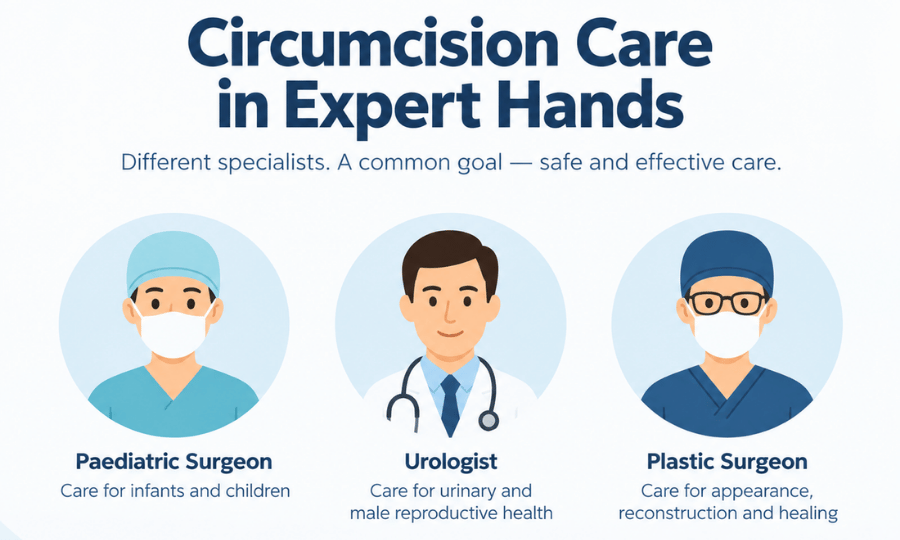
Circumcision is performed by doctors from several surgical specialities. There is no single speciality that is automatically appropriate for every patient.
Paediatric Surgeons
Paediatric surgeons specialise in surgical conditions affecting infants and children. They may be particularly appropriate when circumcision involves:
- Babies or young children
- Congenital penile conditions
- Difficult foreskin abnormalities
- Previous childhood surgery
- A child who requires general anaesthesia
- Cases requiring broader paediatric surgical assessment
Age matters because operating on a child involves considerations that are different from those in an adult, including anaesthesia, consent, pain management and postoperative care.
Parents considering the procedure can read more about Choosing a baby circumcision doctor.
Urologists
Urologists specialise in conditions involving the urinary system and male genital tract.
Circumcision may be performed by a urologist when it is associated with conditions such as:
- Phimosis
- Recurrent balanitis
- Urinary problems
- Other penile conditions
- Associated urological abnormalities
- Previous urological procedures
If the foreskin problem is only one part of a wider urinary or genital condition, urological assessment may be particularly relevant.
Plastic Surgeons
Plastic surgeons are trained in surgery involving skin, soft tissue, reconstruction, wound healing and scar management.
They may perform routine circumcision as well as assess patients in whom there are additional concerns about:
- Scar position
- Skin distribution
- Previous circumcision scars
- Cosmetic appearance
- Wound-healing problems
- Revision surgery
- Reconstruction after an unsatisfactory previous result
The surgeon's speciality alone, however, should not be used as a guarantee of outcome. Relevant experience with the particular procedure and case type remains important.
For a broader checklist, patients can review How to choose a circumcision surgeon.
Referral Matrix: Which Circumcision Cases May Need Which Setting?
The following table provides a practical framework rather than a rigid rule. The appropriate clinician and setting depend on examination, age, medical history, and local facilities.
| Case type | Appropriate speciality | Setting required | Anaesthesia backup | When to refer onward |
|---|---|---|---|---|
| Straightforward adult circumcision | Surgeon experienced in adult circumcision, which may include a urologist or plastic surgeon | Properly equipped surgical facility | Appropriate local or other anaesthesia support | Complex anatomy, significant medical illness or previous surgical complication |
| Newborn or infant | Appropriately trained clinician with neonatal/paediatric experience | Facility suitable for infants | Age-appropriate pain-control and emergency arrangements | Congenital abnormality, uncertain anatomy or significant medical condition |
| Toddler or older child | Commonly paediatric surgical care or another appropriately experienced surgical team | Child-appropriate surgical facility | Paediatric anaesthesia capability when required | Complex anatomy, anaesthetic concern or associated congenital condition |
| Adult with phimosis or recurrent infection | Surgeon experienced in foreskin disease; urological input may be appropriate | Suitable surgical facility | According to procedure and patient health | Suspicious skin disease, complex urinary symptoms or difficult anatomy |
| Previous poor circumcision result | Surgeon experienced in revision/reconstructive surgery | Equipped surgical setting | Depends on extent of revision | Significant tissue loss, deformity or complex reconstruction |
| Significant associated penile abnormality | Relevant specialist team | Hospital/specialist surgical facility | Appropriate anaesthesia support | Specialist evaluation is generally required before proceeding |
This matrix also helps answer where to get circumcision done safely. The procedure should be matched to both the patient's needs and the capabilities of the facility.
Which Cases Are Routinely Handled at a Taluka or District Hospital?
Some straightforward circumcision cases may be managed at general, taluka or district hospitals when appropriately trained clinicians, sterile surgical facilities, anaesthesia support and postoperative care are available.
Whether a case is suitable depends on more than the hospital's label.
A straightforward patient may require relatively limited resources, while another patient may need specialist assessment because of age, anatomy, previous surgery or medical conditions.
Therefore, when asking if circumcision is done at a general hospital, patients should also ask whether that particular hospital routinely manages their type of case.
A facility performing circumcision should have systems for:
- Sterile surgery
- Safe anaesthesia or local anaesthetic administration
- Monitoring when required
- Bleeding control
- Postoperative observation
- Emergency response
- Follow-up
- Referral if an unexpected problem develops
A hospital does not need to be the largest facility in the region for every routine case, but it should be properly equipped for the patient being treated.
Patients can use choosing the hospital as a more detailed checklist when comparing facilities.
Which Situations Should Be Referred Onward?
Not every circumcision should be approached as a routine procedure.
Referral to a more specialised surgeon or facility may be appropriate when examination identifies unusual anatomy or additional medical concerns.
Examples can include:
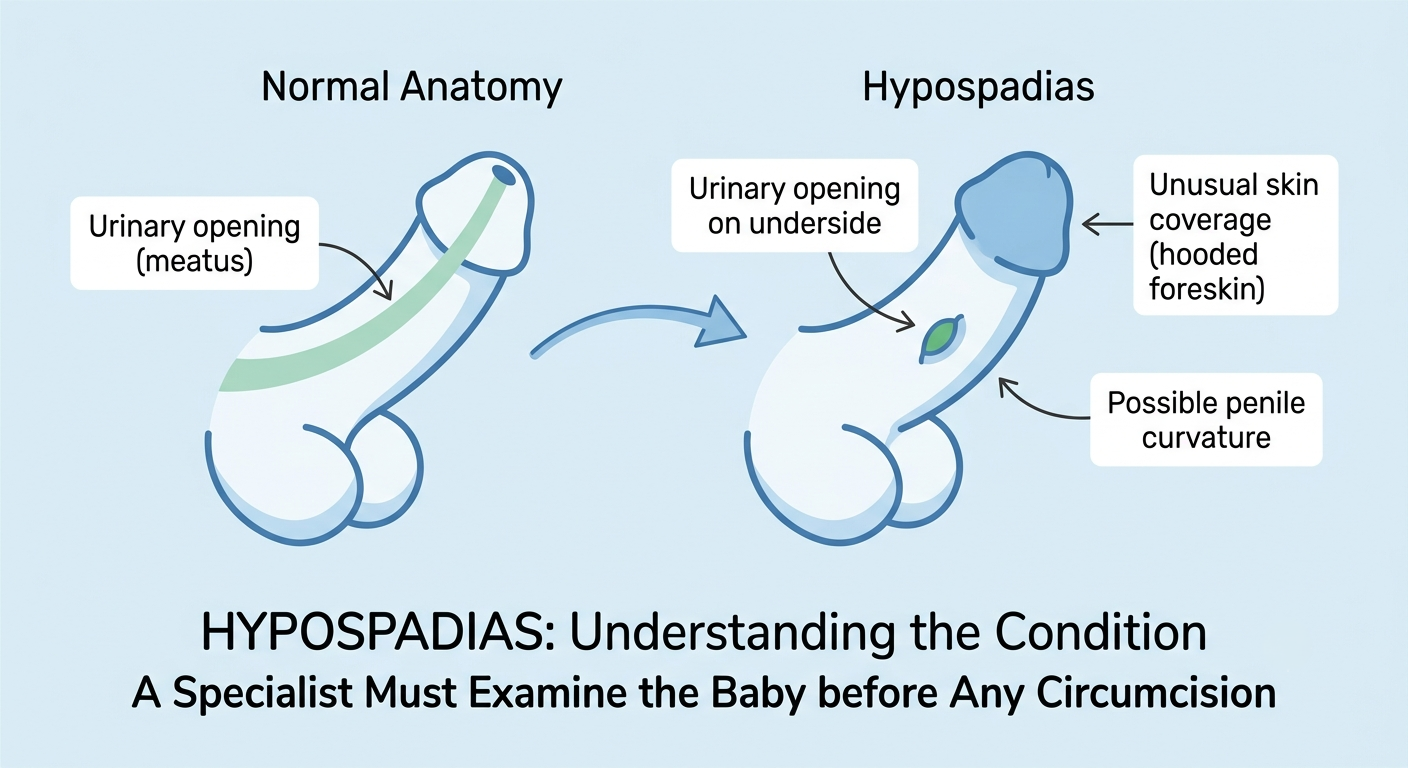
- Congenital penile abnormalities
- Significant penile curvature
- Uncertain position of the urethral opening
- Previous unsuccessful circumcision
- Excessive or inadequate skin removal from earlier surgery
- Significant scar deformity
- Recurrent wound problems
- Complex foreskin disease
- Significant bleeding disorders
- Serious uncontrolled medical conditions
- Anaesthetic concerns
- Cases requiring reconstructive surgery
This is particularly important in children with an anatomical abnormality. The foreskin may sometimes have potential reconstructive value, so performing circumcision before specialist assessment may not be appropriate.
The safest decision in an unusual case may therefore be not to proceed immediately until the anatomy has been properly assessed.
What Should Be Verified About the Setting and Anaesthesia Backup?
Choosing a qualified surgeon is only one part of safe treatment.
Patients should also ask where the procedure will actually take place.
Important questions include:
- Is the procedure performed in a properly equipped surgical environment?
- What anaesthesia is planned?
- Who will administer or supervise the anaesthesia?
- Is monitoring available when required?
- What happens if unexpected bleeding occurs?
- Is emergency equipment available?
- How long will observation continue after surgery?
- Who should be contacted if a problem develops after discharge?
- Where will follow-up appointments take place?
The anaesthesia requirements vary considerably.
A cooperative adult having a straightforward procedure may have different requirements from a toddler who cannot safely remain still during surgery. Similarly, a patient with significant medical conditions may require additional assessment or monitoring.
The appropriate setting should therefore be determined by the patient and procedure, rather than choosing a facility only because it offers circumcision.
Does the Doctor's Speciality Affect Complication Risk?
The speciality name alone does not determine whether a complication will occur.
Circumcision complications can include:
- Bleeding
- Infection
- Wound separation
- Excessive swelling
- Scar problems
- Removal of too much or too little skin
- Unsatisfactory appearance
- Need for revision
Risk is influenced by several factors, including the patient's health, anatomy, surgical technique, sterility, anaesthesia, postoperative care and the surgeon's experience with the particular type of case.
A surgeon who regularly performs the relevant procedure and knows when a case should be referred may be more appropriate than selecting someone based only on the speciality written after their name.
Which Registration and Qualification Details Can a Patient Check?
Patients have a reasonable basis for asking about the qualifications to check before circumcision.
Before proceeding, patients or parents can ask about:
- Medical qualification
- Surgical speciality and postgraduate training
- Professional registration
- Experience performing circumcision
- Experience with the patient's age group
- Experience managing the specific condition
- Hospital or facility where surgery is performed
- Anaesthesia arrangements
- Follow-up arrangements
- Management of complications
Registration details can generally be checked through the relevant medical registration authority.
A professional consultation should also allow the patient to understand who will actually perform the procedure rather than assuming that the doctor seen initially will necessarily be the operating surgeon.
Information about the Elegance Clinic treatment team is available through About the clinic and team.
Who Should Perform Revision Circumcision?
Revision requires a different assessment from a first circumcision.
A patient may seek revision because of:
- Uneven remaining skin
- An uncomfortable scar
- Excessive residual foreskin
- Too-tight skin
- Skin bridges or adhesions
- Persistent cosmetic concern
- Functional discomfort
- Problems following wound healing
The surgeon first needs to determine what tissue remains and whether another procedure can safely improve the problem.
This is particularly important when too much skin has already been removed. Revision does not simply mean performing another standard circumcision.
Patients with complex scars, tissue deficiency, or deformity may need a surgeon experienced in reconstructive techniques rather than routine circumcision alone.
What Should a Family Ask Before Agreeing to a Date?
Patients and parents should understand the treatment plan before scheduling surgery.
Useful questions include:
- Why is circumcision being recommended?
- Are there reasonable alternatives?
- Who will operate?
- Does the surgeon regularly perform this type of circumcision?
- Which technique is planned and why?
- What anaesthesia will be used?
- Where will the operation take place?
- What are the main risks in this particular case?
- What will wound care involve?
- When is the first follow-up?
- Who should be contacted if bleeding, fever, increasing pain, or another concern develops?
- Could anything about the examination require referral to another specialist?
Patients should receive answers that relate to their own condition rather than only general assurances about the procedure.
Choosing the Right Doctor for Circumcision
So, which doctor performs circumcision safely? Paediatric surgeons, urologists and plastic surgeons may all perform circumcision within their training and experience. The appropriate choice depends on the patient's age, anatomy, reason for surgery and complexity of the case. Rather than selecting a doctor solely by speciality, patients should consider relevant procedural experience, medical registration, surgical setting, anaesthesia support, follow-up arrangements and whether the surgeon recognises situations that require onward referral. At Elegance Clinic, Surat, Dr. Ashutosh Shah, a plastic surgeon with 22+ years of experience, assesses each patient individually so that the planned procedure, surgical environment, and postoperative care can be matched to the patient's specific requirements.