Laser, Stapler, Ring or Conventional? Choosing a Circumcision Method
No single circumcision method is best for everyone: laser and conventional surgery suit most adults, stapler and ring devices reduce operating time and stitches, and the right choice depends on anatomy, age, comorbidity, and how much downtime is acceptable.
For someone reading a circumcision best method guide, the important question is therefore not simply, “Is laser better?” Modern circumcision can be performed using different techniques, but each has its own practical advantages, limitations, and suitability criteria. A method that works well for one patient may not be appropriate for another.
At Elegance Clinic, Surat, Dr. Ashutosh Shah, a plastic surgeon with 22+ years of experience, assesses the reason for circumcision, foreskin condition, anatomy, age, medical history, and recovery priorities before discussing an appropriate method.
What Actually Differs Between Laser, Stapler, Ring and Conventional Circumcision?
All four approaches aim to deal with the foreskin, but they differ in how tissue is removed or controlled and how the wound is managed.
Laser Circumcision
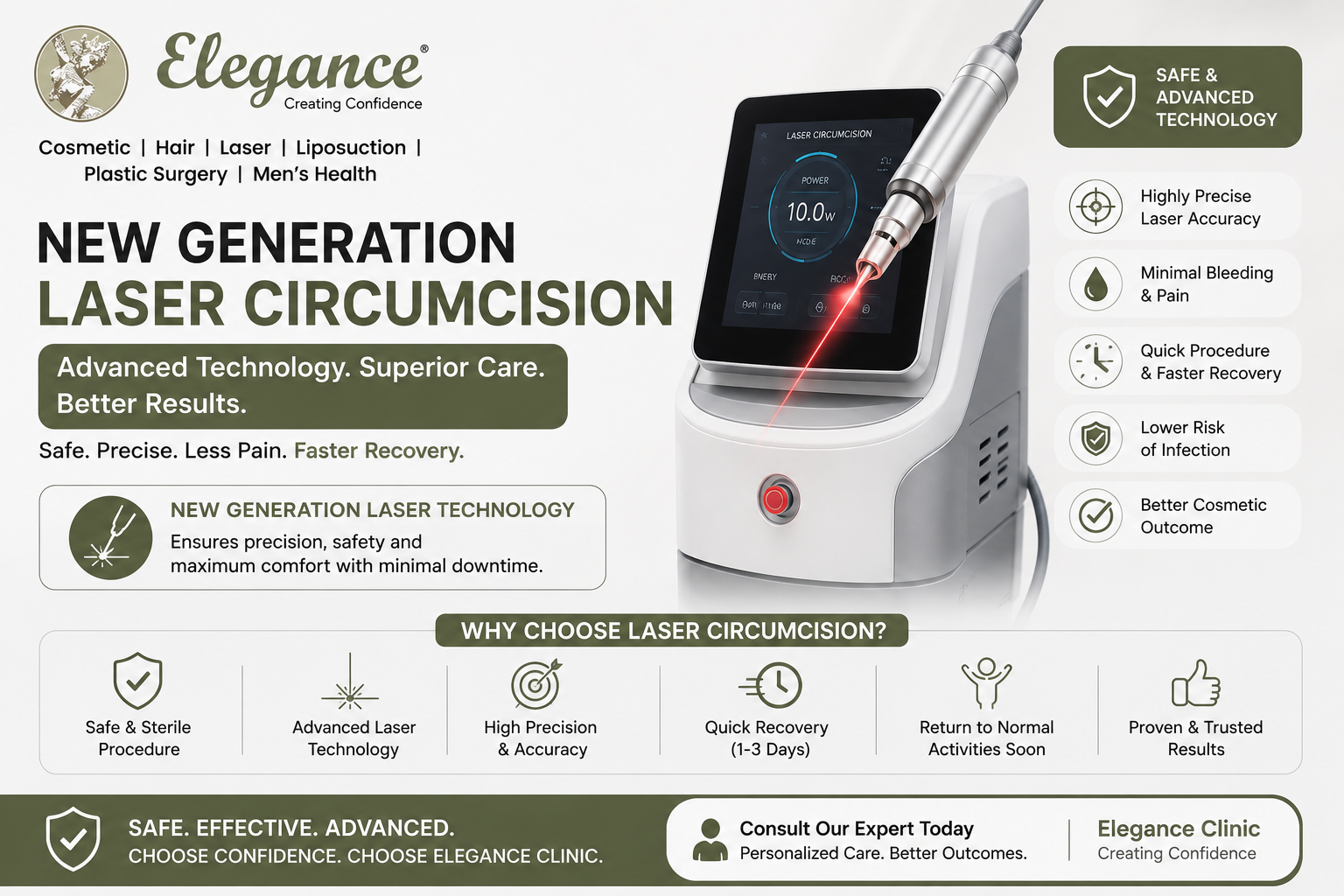
Laser circumcision uses laser energy as a surgical cutting and coagulation tool. The surgeon still determines how much foreskin should be removed and where the final scar should sit.
Laser does not mean that there is no wound, no anaesthesia, or no recovery period.
Patients specifically researching this technique can read the Laser circumcision service page.
Stapler Circumcision
A circumcision stapler is a disposable device designed to remove foreskin and close the cut edge using staples.
The device can standardise parts of the procedure and may reduce operating time in suitable patients.
However, the anatomy must be appropriate for the device. The cost of the disposable stapler can also increase the overall treatment price.
For more details, see ZSR stitchless circumcision.
Ring Circumcision
Ring-based circumcision uses a specially designed device that controls the foreskin while the treated tissue separates or is removed according to the particular device technique.
Some ring systems can reduce the need for conventional suturing.
However, the device must be correctly sized, and follow-up requirements differ from standard surgical circumcision.
Patients comparing ring and surgical methods can read ShangRing versus the traditional method.
Conventional Circumcision
Conventional circumcision involves direct surgical removal of the required foreskin followed by wound closure.
Its major advantage is flexibility. The surgeon can directly adjust the amount and position of skin removal according to the patient's anatomy and condition.
It may therefore remain useful when scarring, previous surgery or unusual anatomy makes a standardised device less suitable.
Circumcision Method Comparison Table
Exact operating and healing times vary between patients, so they should not be treated as guarantees.
| Method | Anaesthesia | Operating Time | Stitches | Healing | Scar Appearance | Who It May Suit | When It May Not Suit |
|---|---|---|---|---|---|---|---|
| Laser | Usually local or another appropriate plan | Generally a short procedure | May still require sutures | Several weeks for progressive healing | Depends on technique and healing | Many adults suitable for surgical circumcision | Anatomy or medical circumstances requiring another approach |
| Stapler | Appropriate anaesthesia required | Often relatively quick | Conventional sutures may be reduced/replaced by staples | Progressive healing over several weeks | Usually a defined circumferential line | Selected adults with suitable anatomy | Cases unsuitable for device sizing or requiring customised reconstruction |
| Ring | Depends on age, device and patient | Device placement can be relatively quick | Often avoids conventional suturing | Device-specific healing period | Circumferential scar after healing | Selected adults or children depending on device | Unsuitable anatomy, sizing or other clinical factors |
| Conventional | Local or other appropriate anaesthesia | Depends on complexity | Usually sutures | Progressive healing over several weeks | Surgeon-controlled but healing varies | Broad range of routine and complex cases | Suitability depends on general surgical/anaesthetic assessment |
The table is a comparison framework rather than a promise of a specific result.
Which Method Suits Which Patient?
Choosing a technique requires more than comparing procedure times.
The surgeon may consider:
- Patient age
- Degree of phimosis
- Foreskin scarring
- Repeated infections
- Previous circumcision or foreskin surgery
- Amount and distribution of available skin
- Diabetes or other medical conditions
- Anaesthesia requirements
- Patient preference
- Expected downtime
- Suitability for a particular device
A patient looking for the Safest circumcision method for adults should therefore expect an individual assessment rather than one universal answer.
Laser vs Conventional Circumcision
The laser vs conventional circumcision comparison is one of the most common questions asked during consultation.
The main difference is the surgical tool used for cutting and controlling bleeding.
Laser surgery uses laser energy. Conventional surgery uses standard surgical instruments and haemostasis techniques.
Laser may help with precise tissue cutting and bleeding control in suitable circumstances. Conventional surgery, however, gives the surgeon considerable flexibility in determining the amount and shape of skin removal.
Importantly, laser does not automatically mean:
- No pain
- No swelling
- No stitches
- No scar
- Instant healing
- No postoperative care
Both are surgical procedures and require appropriate wound healing.
The better choice depends on the actual clinical situation.
Stapler Circumcision Comparison
A stapler can make certain steps of circumcision more standardised.
It may be attractive to patients because the operating stage can be relatively quick, and traditional hand-placed sutures may be reduced or avoided depending on the device.
However, a stapler circumcision comparison should also consider its limitations.
The device needs to fit the patient's anatomy appropriately. It also creates a relatively standardised line of tissue removal, whereas direct surgery gives the surgeon more freedom to modify the operation.
The disposable device also contributes to the cost.
Stapler circumcision is therefore an option rather than an automatic upgrade from conventional surgery.
Ring Circumcision for Adults
Ring circumcision for adults is another device-based approach.
Ring techniques can reduce some of the cutting and suturing steps associated with conventional surgery, but the patient must be suitable for the particular device.
Device size and anatomy are important.
Patients also need to understand what happens after the device is placed, including:
- Expected swelling
- Device care
- Hygiene
- Follow-up
- When the device is removed or separates, depending on technique
- Which symptoms require earlier review
A shorter operating procedure does not necessarily mean that the entire healing process is complete sooner.
How Do Healing Time and Stitches Compare Between Methods?
Patients often ask which circumcision method heals fastest.
There is no reliable single answer for every patient because healing depends on more than the surgical device.
Factors include:
- Age
- General health
- Diabetes control
- Smoking
- Infection
- Degree of swelling
- Surgical complexity
- Wound care
- Individual healing response
Conventional Circumcision
Sutures are usually used to close the wound. Depending on the material, they may dissolve during healing.
Laser Circumcision
Laser refers to the cutting/coagulation method. Sutures may still be required.
This is important because “laser” and “stitchless” are not interchangeable terms.
Stapler Circumcision
The device uses staples to approximate the wound edges rather than relying entirely on conventional hand suturing.
Device-specific aftercare is required.
Ring Circumcision
Many ring methods avoid conventional suturing, but healing continues after the device has been applied.
Regardless of method, patients should judge the final appearance only after swelling and wound healing have progressed.
Do Stapler and Ring Methods Leave a Visible Line?
Every circumcision creates a transition between the remaining shaft skin and the area where foreskin has been removed.
After complete healing, this forms a circumferential scar.
Its appearance can vary according to:
- Technique
- Amount of foreskin removed
- Scar position
- Skin pigmentation
- Swelling
- Individual scar formation
- Healing complications
A device can create a relatively regular circumferential treatment line, but no technique can guarantee an invisible scar.
What Does Each Method Cost and Why?
The cost of circumcision depends on more than the technique name.
A quotation may include:
- Surgeon fee
- Anaesthesia
- Theatre or procedure-room charges
- Day-care charges
- Disposable device
- Medicines
- Dressings
- Follow-up
Conventional surgery generally does not require a specialised circumcision device.
Stapler and ring procedures involve a disposable device, which can add to the total price.
Laser treatment may have different equipment or facility costs.
Therefore, when comparing quotations, patients should ask what is included rather than comparing only the final number.
A higher price does not automatically indicate a better clinical result.
Which Methods Are Unsuitable in Specific Situations?
This is one of the most important parts of a useful circumcision best method guide.
A technique may be effective in general but unsuitable for a particular patient.
Significant Scarring
Extensive scarring or distorted anatomy may require more customised tissue removal than a standardised device can provide.
Previous Circumcision or Revision Surgery
Revision cases can involve uneven remaining skin, scar tissue, or other anatomical changes.
Direct surgical planning may sometimes provide greater flexibility.
Active Infection or Significant Inflammation
Surgery may sometimes need to be delayed until an active local problem has been assessed and treated.
Anatomy Unsuitable for a Device
Stapler and ring systems depend on appropriate sizing and anatomy.
If the surgeon cannot use a device safely or achieve the intended result, another technique may be recommended.
Medical Conditions Affecting Healing
Diabetes and other conditions affecting healing do not automatically dictate one circumcision method.
Instead, the surgeon needs to consider the patient's overall health, disease control, infection risk, and wound-healing factors.
The technique should not be chosen simply because one method is advertised as being “best for diabetics.”
Is Any Circumcision Method Completely Painless?
No surgical technique should be promised as completely painless.
Appropriate anaesthesia is used to control pain during the procedure. The anaesthetic plan depends on the patient's age, procedure, and medical circumstances.
After surgery, some degree of:
- Tenderness
- Swelling
- Sensitivity
- Dressing discomfort
may occur during healing.
Pain-control instructions should be discussed before discharge.
Terms such as “painless laser circumcision” or “completely painless stapler circumcision” can create unrealistic expectations. A better question is how pain will be controlled during and after the chosen procedure.
Which Method Suits a Diabetic Patient?
Diabetes does not automatically make laser, stapler, ring, or conventional surgery the correct choice.
The more important issues include:
- Blood glucose control
- Existing infection
- Skin condition
- Circulation where clinically relevant
- Other medical conditions
- Medicines
- Healing risk
The surgeon may request appropriate medical evaluation before proceeding.
Good preoperative planning and postoperative wound care can be more important than choosing a procedure solely because it uses a particular device.
How Is the Method Finally Agreed at Consultation?
The final choice should follow examination and discussion.
During consultation, the surgeon assesses the foreskin and discusses why circumcision is being considered.
The decision may include:
Anatomy: Is there enough suitable tissue for the proposed technique?
Scarring: Is there a tight scarred ring or repeated cracking?
Medical indication: Is the procedure for phimosis, recurrent inflammation, another condition, or personal choice?
Previous treatment: Has conservative treatment or previous surgery already been attempted?
Health: Are there conditions that could influence anaesthesia or healing?
Recovery priorities: How much time can the patient realistically allow for wound care and activity restrictions?
Preference: Does the patient understand the advantages and limitations of each suitable option?
Only after these factors are considered should the method be finalised.
In some circumstances, the planned approach may need to change if examination or findings on the procedure day make another method safer or more appropriate. Any significant change should be explained as part of the consent process.
Choosing the Right Circumcision Method
A useful circumcision best method guide should not conclude that laser, stapler, ring, or conventional surgery is automatically superior. Laser and conventional techniques provide surgical flexibility, while stapler and ring systems can simplify particular procedural steps in appropriately selected patients. Stitches, operating time, device cost, scar characteristics, and aftercare differ, but recovery also depends heavily on the patient's anatomy, health, and healing response. At Elegance Clinic, Surat, Dr. Ashutosh Shah can assess the foreskin, reason for surgery, medical history, and recovery priorities before discussing which of the suitable techniques best matches the individual treatment plan.