Penile Implant Surgery for Erectile Dysfunction: What It Can and Cannot Do
A penile implant is a device placed surgically when tablets, injections, and other erectile dysfunction treatments have not worked or are unsuitable. Although implants can provide reliable erections for many years, they are better described as durable rather than permanent, because every mechanical device has a finite lifespan and may eventually require revision or replacement.
Penile implant surgery is generally considered a later-line treatment for erectile dysfunction (ED), not the first treatment offered after erection difficulties begin. Before considering surgery, the cause of ED and appropriate non-surgical options should usually be evaluated.
At Elegance Clinic, Surat, Dr. Ashutosh Shah, a plastic surgeon with 22+ years of experience, evaluates surgical concerns individually. Patients considering an implant can also review the Penile Implant Treatment Guide to understand the treatment pathway in more detail. Penile implant surgery specifically requires assessment by an appropriately trained surgeon experienced in prosthetic urology and men's sexual health.
When Is a Penile Implant Considered Rather Than Other Treatments?
Erectile dysfunction means consistently having difficulty achieving or maintaining an erection sufficient for sexual activity.
ED can have many causes, including:
- Diabetes
- Vascular disease
- Nerve damage
- Pelvic surgery
- Certain medications
- Hormonal disorders
- Psychological factors
- Neurological conditions
- Severe penile conditions in selected cases
Because the causes vary, treatment usually follows a stepwise approach.
Depending on the patient's condition, treatment before an implant may include lifestyle changes, management of underlying diseases, oral ED medicines, vacuum erection devices, or penile injections.
A penile implant may be considered when these treatments:
- Do not provide adequate erections
- Cause unacceptable side effects
- Are medically unsuitable
- Are difficult for the patient to use
- No longer work reliably
- Do not provide satisfactory results despite appropriate use
An implant may also be considered in selected men with complex ED after certain pelvic or penile conditions.
Before proceeding to an implant, patients should understand the available Surgical Options for ED and why one approach may be more appropriate than another.
The key point is that surgery is usually considered when less-invasive ED treatments have been appropriately evaluated first.
What Does a Penile Implant Actually Do?
A penile implant is placed inside the penis to provide mechanical rigidity when an erection is required.
It does not cure the underlying vascular, neurological, or metabolic cause of erectile dysfunction.
Instead, it provides a mechanical solution to the erection problem.
This distinction matters because patients sometimes assume an implant restores the natural erection mechanism. It does not.
Depending on the device, the patient either activates an inflatable system or manually positions a malleable implant.
The device is internal, so there is generally no external erection device that needs to be attached before sexual activity.
How Do Inflatable and Malleable Devices Differ?
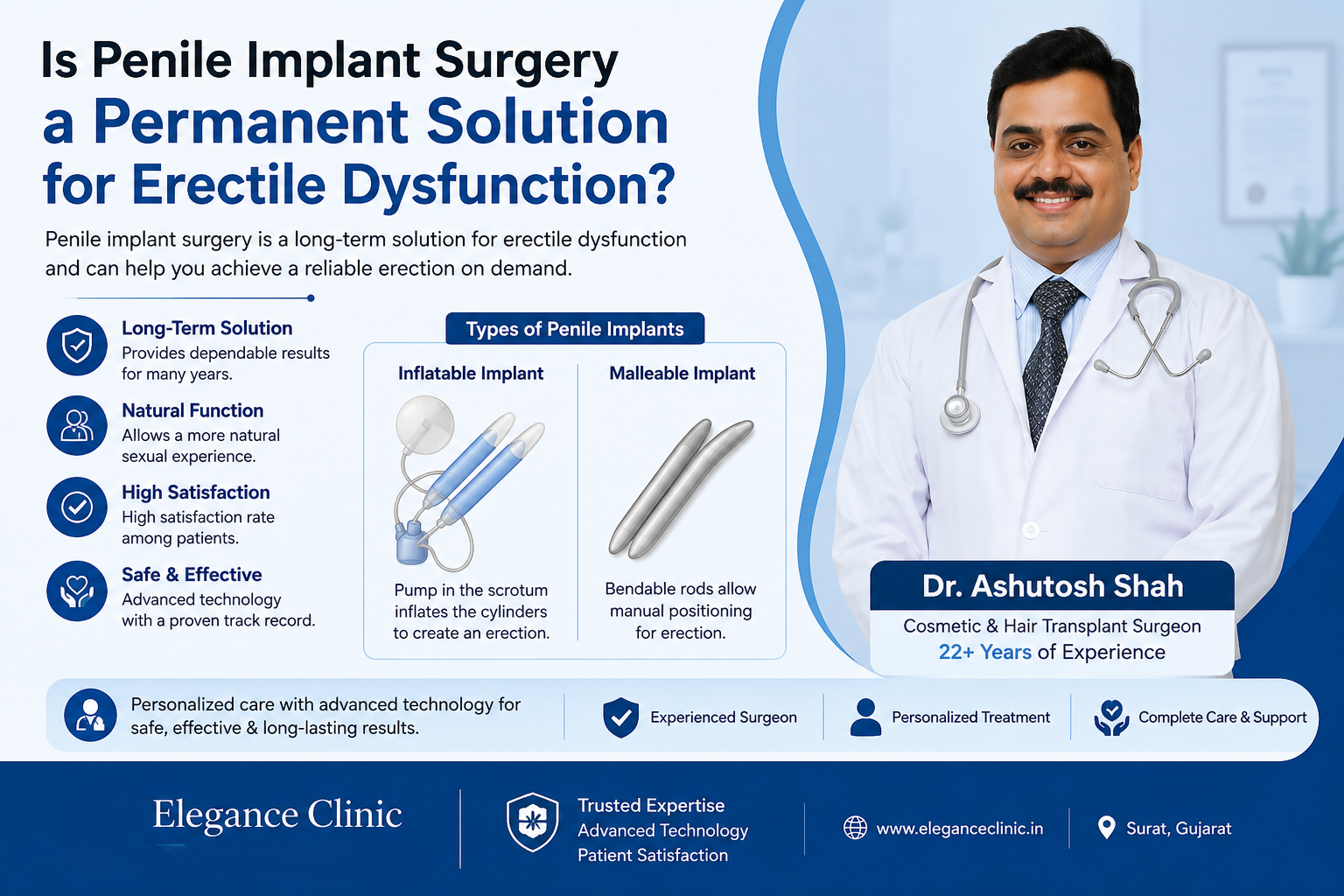
The two broad erectile dysfunction implant options are inflatable and malleable implants.
Inflatable Penile Implant
An inflatable implant commonly consists of cylinders placed inside the penis, a pump positioned within the scrotum, and, depending on the design, a fluid reservoir.
When an erection is wanted, the patient activates the pump. Fluid moves into the cylinders, producing rigidity.
After sexual activity, the device is deflated according to its design.
Inflatable devices can provide a more natural change between a soft and erect state, but they contain mechanical components that can eventually wear or malfunction.
Malleable Penile Implant
A malleable implant uses bendable rods positioned inside the penis.
The penis remains relatively firm and is manually positioned upward for sexual activity and downward at other times.
Malleable implants are mechanically simpler because they do not require a pump or fluid-transfer system.
However, the penis remains semi-rigid rather than returning to the same soft state achievable with an inflatable device.
Inflatable Versus Malleable Implant
| Implant type | How it works | Advantages | Limitations | Typical lifespan | Revision considerations |
|---|---|---|---|---|---|
| Inflatable implant | Internal cylinders are filled using an implanted pump | More natural transition between flaccid and erect states; concealed internally | More mechanical components; requires ability to operate the pump | Often functions for many years, but lifespan varies | Mechanical failure, infection, or other complications may require revision |
| Malleable implant | Bendable internal rods provide continuous firmness | Simpler mechanism; easier operation for some patients | Penis remains semi-rigid; concealment can be more difficult | Can remain functional for many years | Revision may be needed for infection, erosion, mechanical/device problems, or patient-related concerns.s |
A specific number of years should not be treated as a guarantee. Device survival varies with implant design, patient factors, surgical circumstances, and length of follow-up.
What Does the Operation and Hospital Stay Involve?
During penile implant surgery, the prosthetic components are surgically positioned inside the penis.
The exact procedure varies according to the type of implant and the patient's anatomy.
Anaesthesia may be general or regional depending on the patient, surgical team, and clinical circumstances.
The surgical area is prepared carefully because infection prevention is particularly important when placing any prosthetic device.
For an inflatable implant, cylinders are positioned within the erectile bodies of the penis. Additional components such as the pump and reservoir are placed internally according to the device design.
For a malleable implant, appropriately sized rods are placed within the penis.
The incision is then closed, and postoperative dressings are applied as required.
Some patients may be discharged relatively soon after surgery, while others may require a longer period of observation. Hospital stay depends on the procedure, medical history, anaesthesia, recovery and surgeon's protocol.
Patients who want more information about evaluation, the procedure and recovery can review the Penile Implant Service Page.
Is Penile Implant Surgery a Permanent Solution?
This question needs careful wording.
A penile implant is designed as a long-term surgical treatment, but describing it simply as a permanent solution can be misleading.
The implant changes the erectile anatomy surgically, and patients should generally approach implantation as a major long-term treatment decision.
However, the device itself is not guaranteed to last for the rest of the patient's life.
Mechanical components can eventually fail. Infection, erosion, or other complications can also require removal or revision.
Therefore:
Long-term treatment does not mean lifetime device guarantee.
This distinction is especially important for younger patients, who may have more years during which a future revision could become necessary.
What Is the Realistic Lifespan of a Device?
Patients frequently ask, " How long does a penile implant last?
Modern implants can remain functional for many years, and long-term studies show good device survival. However, there is no single expiration date that applies to every implant.
The chance of requiring revision generally increases with longer follow-up because mechanical components can wear over time.
Device longevity can be affected by:
- Implant design
- Frequency of use
- Mechanical wear
- Patient anatomy
- Infection
- Surgical factors
- Device-specific complications
- Length of time since implantation
Rather than promising that an implant will last a fixed number of years, patients should understand that it is a durable prosthetic device with a possibility of future revision.
If a device continues to function well and causes no problems, it is not routinely replaced merely because it reaches a particular age.
Which Risks and Complications Must Be Discussed Before Consent?
Penile implantation is an established surgical treatment, but it is still an operation involving a prosthetic device.
Potential complications should be discussed before informed consent.
Infection
Infection is one of the most important complications because bacteria involving an implanted prosthesis can be difficult to treat with medication alone.
In some cases, an infected implant may need to be removed or surgically managed.
Certain medical conditions may affect infection risk, which is why preoperative assessment and optimisation are important.
Mechanical Failure
Inflatable implants contain mechanical components.
Over time, a component can malfunction, leak or stop operating correctly.
Mechanical failure may require another operation to repair or replace part or all of the system.
Erosion
Rarely, part of an implant can erode into surrounding tissue.
This requires specialist assessment and may require further surgery.
Pain
Postoperative pain is expected during early recovery. Persistent or unusual pain requires assessment.
Bleeding and Swelling
Bruising and swelling can occur after surgery. Significant bleeding or an expanding swelling needs medical review.
Changes in Perceived Length
An implant provides rigidity but does not function as a penile enlargement procedure.
Some men perceive their penis as shorter after implantation, particularly when ED has been present for a long time or when other penile conditions have caused tissue changes.
Preoperative counselling about realistic size expectations is therefore important.
Anaesthesia and General Surgical Risks
As with other operations, anaesthesia, wound healing and the patient's underlying health contribute additional risks.
Does a Penile Implant Affect Sensation or Orgasm?
A penile implant primarily changes the mechanism used to create rigidity.
It is not designed to remove the sensory nerves responsible for normal penile sensation.
Therefore, men who had normal sensation and orgasm before surgery may often retain these functions.
However, individual outcomes can differ, particularly when the underlying condition causing ED also affects nerves or sexual function.
An implant also does not automatically increase sexual desire.
Libido depends on many factors, including:
- Hormonal health
- Psychological wellbeing
- Relationship factors
- Medications
- General health
A mechanically firm erection and sexual desire are separate aspects of sexual function.
What Does Recovery and First Use Look Like?
Recovery after penile implant surgery occurs gradually.
During the first several days, patients can expect some swelling, tenderness, and discomfort around the operative area.
Pain medication and wound-care instructions are provided according to the surgeon's protocol.
Patients may initially need to limit:
- Heavy lifting
- Strenuous exercise
- Activities that put pressure on the surgical area
- Sexual activity
The incision and surrounding tissues need sufficient time to heal before the device is used for intercourse.
With an inflatable device, patients are also taught how to operate the pump correctly.
The timing of activation varies according to healing and the surgeon's protocol. Patients should not attempt early use simply because discomfort has improved.
The surgeon should confirm at follow-up when the device can be activated and when sexual activity can safely resume.
What Happens If the Device Fails?
Device failure does not necessarily mean there are no further treatment options.
A malfunctioning implant can often be surgically revised or replaced.
The exact approach depends on:
- Which component has failed
- Device type
- How long the implant has been present
- Presence or absence of infection
- Condition of the surrounding tissues
- Patient's overall health
Revision surgery can be more complex than first-time implantation because scar tissue may be present.
This possibility should be discussed before the original implant procedure so that patients understand the long-term commitment involved.
Who May Not Be Ready for Penile Implant Surgery?
Not every man with ED should immediately proceed to implantation.
Further evaluation may be needed when:
- The cause of ED has not been properly investigated
- Appropriate less-invasive treatments have not been tried
- There is an active infection
- Diabetes or another medical condition requires better optimisation
- Expectations about penile size are unrealistic
- The patient expects the implant to increase libido
- The patient expects completely natural spontaneous erections
- The patient has not understood the possibility of future revision
The best candidates understand both what the device can accomplish and what it cannot.
A Durable Treatment, Not a Lifetime Guarantee
Penile implant surgery can provide dependable erections for appropriately selected men whose erectile dysfunction has not responded adequately to less-invasive treatments. However, it should not be marketed simply as a "permanent cure." The implant mechanically produces rigidity without correcting the original vascular, neurological, or metabolic cause of ED, and the device itself can eventually require revision or replacement. Choosing between inflatable versus malleable implants requires consideration of manual dexterity, concealment, expectations, anatomy, medical history and personal preference. Patients considering implantation should receive detailed counselling about device lifespan, infection, mechanical failure, recovery and possible future surgery. If you need an individual assessment or want to discuss whether implantation is appropriate, contact the Clinic.