What Is the Best Treatment for a Tight Foreskin?
There is no single best treatment for a tight foreskin: mild cases respond to a topical steroid with gentle stretching, a narrow ring may suit preputioplasty, and a scarred or repeatedly infected foreskin is usually treated by circumcision.
The right treatment therefore depends on why the foreskin is tight, how severe the narrowing is, whether scarring or repeated infection is present, and whether preserving the foreskin remains a practical option. Someone with mild tightness and healthy, flexible skin may need a very different treatment from someone with a firm, scarred ring and repeated inflammation.
At Elegance Clinic, Surat, Dr. Ashutosh Shah, a plastic surgeon with 22+ years of experience, assesses the foreskin, symptoms, scarring, and previous treatment before discussing suitable options. Treatment should be selected according to the individual condition rather than assuming that laser, stapler, circumcision, or any other technique is automatically best.
What Makes a Foreskin Tight and How Is Severity Graded?
A tight foreskin is commonly described as phimosis. It means that the foreskin cannot be comfortably retracted behind the glans.
The severity can vary considerably.
In a mild case, the foreskin may retract when the penis is not erect but feel tight during an erection. In a more significant case, only partial retraction may be possible. In severe cases, the opening may be very narrow, and retraction may not be possible at all.
Symptoms may include:
- Difficulty retracting the foreskin
- Tightness during erection
- Pain during sexual activity
- Repeated cracking or small tears
- Redness or inflammation
- Recurrent balanitis
- Difficulty cleaning underneath the foreskin
- A tight visible ring
- Ballooning during urination
- Urinary difficulty in more significant cases
The appearance of the skin is particularly important.
A flexible but narrow foreskin may respond to conservative treatment, whereas a thick, white or scarred ring may make foreskin-preserving treatment less successful.
Instead of repeating the full discussion of phimosis here, patients considering conservative management can read Treating phimosis without surgery.
Comparing Tight Foreskin Treatment Options
There is no universal ranking of tight foreskin treatment options. Each has different indications, recovery requirements, and possibility of recurrence.
| Treatment | Who it suits | Expected time to result | Downtime | Chance of recurrence | When it is not offered |
|---|---|---|---|---|---|
| Topical steroid + gentle stretching | Mild to moderate tightness without major scarring | Usually assessed over several weeks | Minimal | Tightness can recur | Significant scarring, repeated failure or unsuitable skin disease |
| Preputioplasty | Selected patients with a localised tight ring who want foreskin preservation | Improvement after surgical healing | Short surgical recovery | Recurrence remains possible | Extensive scarring or disease making preservation unsuitable |
| Laser circumcision | Patients in whom circumcision is indicated and the technique is suitable | Result after wound healing | Surgical recovery required | Phimosis itself should not recur once the foreskin is removed | When another technique is considered more appropriate |
| Stapler circumcision | Selected patients suitable for device-based circumcision | Result after healing and device-related recovery | Surgical recovery required | Phimosis should not recur after adequate circumcision | Anatomy or clinical circumstances unsuitable for the device |
| Conventional circumcision | Scarred, recurrent or persistent phimosis requiring foreskin removal | Result after surgical healing | Surgical recovery required | Phimosis does not recur once the constricting foreskin is removed | Requires individual assessment for surgical/anaesthetic suitability |
These timelines are general. Recovery and treatment response vary between patients.
Which Cases Are Suitable for Cream and Stretching Alone?
For mild or moderate phimosis without significant scarring, conservative treatment may be considered before surgery.
A clinician may prescribe a topical corticosteroid to be applied to the tight portion of the foreskin for a defined period.
Gentle stretching may also be advised.
The important word is gentle.
Stretching should not cause:
- Pain
- Cracking
- Bleeding
- Skin tearing
- Significant inflammation
Forceful stretching can cause small injuries. When these heal with scar tissue, the opening may become tighter rather than looser.
Conservative treatment is more likely to be considered when the foreskin remains soft and flexible, and there is no significant pathological scarring.
Progress should be reviewed rather than continuing treatment indefinitely without reassessment.
How Long Should Cream and Stretching Be Tried?
A topical steroid is generally prescribed as a defined treatment course, often over several weeks, rather than as a permanent treatment.
During follow-up, the clinician can assess:
- Whether the opening has widened
- Whether retraction has improved
- Whether erections remain painful
- Whether cracking has stopped
- Whether inflammation continues
- Whether scarring is becoming more obvious
If there is meaningful improvement, conservative treatment may continue according to medical advice.
If there is little improvement despite appropriate treatment, simply continuing the same approach for months may not be useful. The diagnosis and next treatment step should be reconsidered.
When Does Preputioplasty Preserve the Foreskin Successfully?
Preputioplasty is a surgical procedure designed to widen a tight foreskin while preserving it.
Instead of removing the foreskin completely, the surgeon releases the narrow section so that the opening becomes wider.
It may be an option when:
- Tightness is relatively localised
- Foreskin preservation is important to the patient
- The remaining skin is suitable for preservation
- There is not extensive pathological scarring
- The anatomy is appropriate for the procedure
The principal difference in foreskin preservation versus circumcision is that preputioplasty keeps the foreskin, while circumcision removes the constricting foreskin.
Preservation also means that recurrent narrowing remains possible in some patients.
Anyone considering this approach can read more about Foreskin preservation surgery.
Which Findings Rule Out Foreskin-Preserving Treatment?
This is an important part of deciding the best treatment for a tight foreskin.
Not every foreskin can reasonably be preserved.
Circumcision may be considered more appropriate when assessment finds problems such as:
- Significant scar formation
- A firm or fibrotic constricting ring
- Repeated cracking and re-scarring
- Recurrent troublesome balanitis
- Persistent symptoms despite appropriate conservative treatment
- Significant skin disease affecting the foreskin
- Previous unsuccessful foreskin-preserving treatment
- Anatomy unsuitable for preputioplasty
- Severe persistent tightness causing functional difficulty
A white, thickened or progressively scarred ring deserves medical assessment rather than repeated forceful stretching at home.
Treatment should address the underlying condition rather than simply trying to make the foreskin retract at any cost.
How Do Laser, Stapler and Conventional Circumcision Compare for This Problem?
When circumcision is considered appropriate, several surgical techniques may be available.
The word "circumcision" describes the removal of foreskin; the surgical method used to achieve that can differ.
Laser Circumcision
Laser-assisted circumcision uses laser energy during parts of the tissue-cutting and bleeding-control process.
It may offer practical advantages in selected cases, but it should not be presented as completely painless or automatically superior to every other technique.
Anaesthesia is still required, and postoperative healing still takes time.
More information is available in Laser circumcision for tight foreskin.
Stapler Circumcision
A circumcision stapler is a specialised device designed to remove foreskin and place closure staples in a controlled manner.
It may be suitable for selected adult patients, but suitability depends on anatomy and the clinical problem.
A device does not replace proper surgical assessment.
Conventional Circumcision
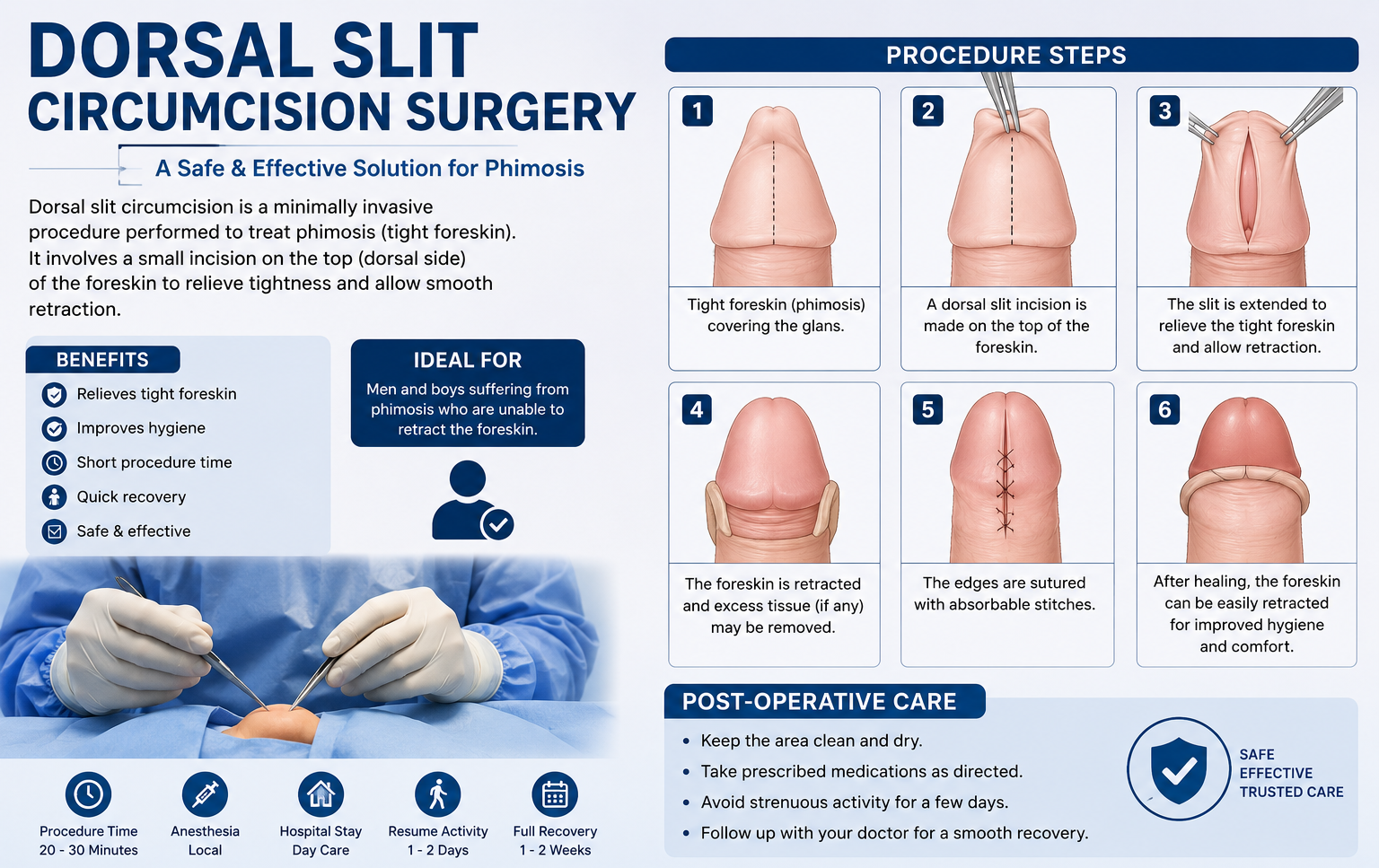
Conventional surgical circumcision remains an established approach in which the surgeon removes the required foreskin and closes the wound appropriately.
It can be particularly relevant when the amount of diseased or scarred tissue requires direct surgical judgement.
The most appropriate technique should therefore be based on the patient's anatomy and condition, not solely on advertising terms such as "latest," "painless," or "advanced."
Is Painless Foreskin Treatment Possible?
The phrase painless foreskin treatment is commonly searched online, but it can create unrealistic expectations.
Treatment can be made more comfortable, but no surgical method should be promised to be completely painless for every patient.
Non-surgical stretching should be gentle and should not be deliberately painful.
For surgical procedures, appropriate anaesthesia is used to control pain during treatment. Depending on the procedure and patient, this may involve local anaesthesia, regional techniques, sedation or another anaesthetic plan.
After surgery, temporary tenderness, swelling and discomfort can occur as tissues heal.
A more useful question is therefore not "Which treatment is painless?" but:
Which treatment is medically appropriate, how will pain be controlled, and what should I expect during recovery?
What Does Recovery Look Like for Each Option?
Recovery varies substantially because cream and stretching are very different from surgical treatment.
Steroid Cream and Stretching
There is usually little or no conventional downtime.
Patients continue treatment over the period prescribed and monitor improvement. Stretching should remain gentle.
The main issue is whether the treatment successfully improves retraction without causing injury.
Preputioplasty
Because preputioplasty is surgery, the wound needs time to heal.
Temporary swelling, tenderness, and restrictions on friction or sexual activity may apply. The exact recovery period depends on the operation and individual healing.
Laser Circumcision
Patients should expect a postoperative healing period despite the use of laser technology.
There may be:
- Swelling
- Tenderness
- Dressing requirements
- Activity restrictions
- Temporary sensitivity
- A period before sexual activity can resume
Stapler Circumcision
Stapler circumcision also requires wound healing. Device-specific aftercare may be necessary, and the surgeon should explain what happens to the staples and when follow-up is required.
Conventional Circumcision
Conventional surgery similarly involves swelling, wound care, and temporary restrictions.
The appearance during the first days or weeks should not be assumed to represent the final healed result.
What If the Foreskin Gets Stuck Behind the Glans?
A tight foreskin sometimes retracts behind the glans but then cannot return to its normal forward position. This condition is different from uncomplicated phimosis and can require urgent medical attention, particularly when swelling develops.
Patients should not repeatedly force a very tight foreskin backwards.
More information is available in Foreskin stuck behind the head.
If the foreskin becomes trapped behind the glans and cannot be brought forward, especially with increasing swelling or pain, prompt medical assessment is appropriate.
How Is the Best Treatment Chosen?
The decision usually starts with examination rather than selecting a technique from a list.
The clinician needs to determine:
Severity: How narrow is the opening and how much retraction is possible?
Scarring: Is the foreskin flexible or is there a firm scarred ring?
Symptoms: Is there pain, cracking, infection, or urinary difficulty?
Previous treatment: Has an appropriate course of conservative treatment already been attempted?
Patient preference: Is foreskin preservation important?
Underlying disease: Is there inflammation or another skin condition contributing to the problem?
Anatomy: Is the patient technically suitable for the proposed procedure?
These factors determine whether conservative treatment, foreskin-preserving surgery, or circumcision is the more appropriate route.
Choosing the Best Treatment for a Tight Foreskin
There is no single best treatment for a tight foreskin for every patient. Mild or moderate tightness without significant scarring may respond to prescribed topical steroid treatment and gentle stretching. A selected patient who wants to preserve the foreskin may be suitable for preputioplasty, while significant scarring, recurrent infection, or failure of appropriate conservative treatment may make circumcision more suitable. If circumcision is required, laser, stapler and conventional techniques each have particular considerations, and none should be described as universally superior or completely painless. At Elegance Clinic, Surat, Dr. Ashutosh Shah, with 22+ years of experience, can assess the severity of tightness, the condition of the foreskin, and previous treatment before discussing the most appropriate option.