Circumcision Without Surgery or Without a Cut? Myths About Laser and No-Cut Methods
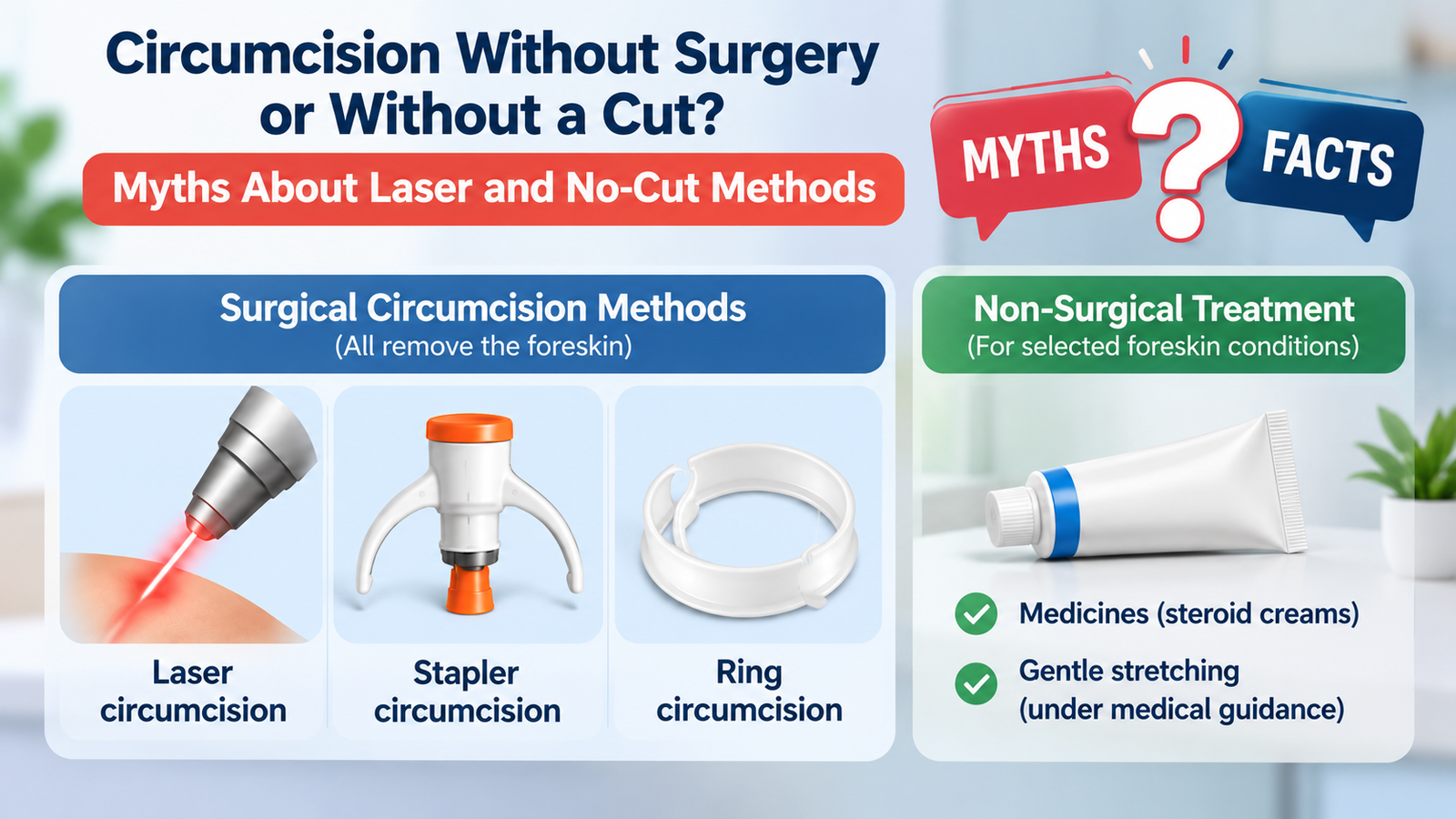
Can circumcision be done without surgery? No. Every circumcision method involves removing the foreskin through a surgical procedure. Laser, stapler, and ring methods use different instruments or techniques, but none eliminates the need for tissue separation. However, some foreskin conditions, including selected cases of phimosis, may improve with medicines without circumcision.
Many men search online for terms such as "no-cut circumcision," "painless foreskin removal," or "circumcision without stitches."
These phrases can create confusion about what actually happens during treatment.
Some patients believe laser circumcision removes the foreskin without an incision, while others assume stapler or ring procedures do not count as surgery.
In reality, every circumcision technique involves separating and removing foreskin tissue.
The important distinction is between surgical circumcision and non-surgical treatment of the underlying foreskin condition.
Understanding this difference helps patients choose appropriate treatment without relying on misleading claims.
Can Circumcision Be Done Without Surgery?
No. Circumcision is, by definition, a surgical procedure that removes the foreskin covering the glans.
Doctors may use different techniques to operate, but each method involves tissue removal.
Common approaches include:
-
Conventional surgical circumcision
-
Laser-assisted circumcision
-
Stapler-assisted circumcision
-
Ring or device-assisted circumcision
The techniques differ in their instruments, wound management, and recovery requirements.
However, none removes the foreskin without a surgical intervention.
What Does No-Cut Circumcision Mean?
"No-cut circumcision" is usually a marketing description rather than a recognised surgical category.
Some clinics use the phrase to describe techniques that avoid a traditional scalpel incision or reduce the need for manually placed stitches.
However, the foreskin still undergoes cutting, compression-related tissue separation, or removal.
Patients should ask exactly how the technique works rather than relying on promotional terminology.
What Does Laser Actually Do During Circumcision?
Laser circumcision uses laser energy to cut or separate foreskin tissue.
Depending on the device and technique, laser energy may also help seal small blood vessels during the procedure.
However, laser circumcision still involves surgical removal of the foreskin.
It does not make the procedure non-invasive.
Is Laser Circumcision Completely Bloodless?
No.
Laser energy may reduce bleeding in selected circumstances by coagulating small blood vessels.
However, bleeding can still occur during or after the operation.
The amount of bleeding depends on the patient's anatomy, medical condition, and surgical technique.
Does Laser Circumcision Need Stitches?
Some laser-assisted procedures use sutures to close the wound.
Other techniques may use different closure methods.
The need for stitches depends on the exact procedure rather than the word "laser."
Patients should ask the surgeon which wound-closure method they plan to use.
For more information, read about laser circumcision.
Is Stapler or Ring Circumcision Non-Surgical?
No. Stapler and ring circumcision are surgical methods.
They use specialised devices to assist with foreskin removal or controlled tissue separation.
Stapler Circumcision
Stapler circumcision uses a device that removes foreskin tissue and places staples during the procedure.
The device may reduce some manual surgical steps, but it does not eliminate tissue cutting.
Patients still require anaesthesia, wound care and postoperative monitoring.
Some staples detach during healing, while others may require removal by a qualified clinician.
Ring Circumcision
Ring-based methods use a specialised device to compress foreskin tissue.
Depending on the device, the foreskin may be removed during the procedure or separate after a period of controlled compression.
Although the process differs from conventional surgery, it still involves tissue removal.
Ring procedures can also cause swelling, discomfort, infection, or other complications.
Does a Device Make Circumcision Painless?
No.
Anaesthesia helps control pain during the procedure.
However, patients may experience discomfort, swelling, or tenderness afterward.
No technique can guarantee a completely painless recovery.
Common Myths About No-Cut Circumcision
Patients should distinguish promotional claims from what the procedure actually involves.
| Marketing Claim | What Actually Happens | What to Ask the Clinic |
|---|---|---|
| No-cut circumcision | Foreskin tissue must still be separated or removed | How exactly is the foreskin removed? |
| Bloodless laser circumcision | Laser energy may reduce bleeding, but bleeding remains possible | What happens if bleeding occurs? |
| Scarless circumcision | Surgical wound healing creates a scar, although visibility varies | Where will the scar be located? |
| Completely painless surgery | Anaesthesia controls procedural pain, but recovery discomfort may occur | Which anaesthesia and pain medicines will be used? |
| No anaesthesia needed | Circumcision generally requires appropriate anaesthesia | How will pain be controlled? |
| No-stitch circumcision | Some devices avoid manually placed sutures but still create a wound | Will staples, rings or another closure method be used? |
| Instant recovery | Healing takes time regardless of technique | When can normal activities resume? |
| Zero complications | Every surgical procedure carries risks | What complications should I watch for? |
Patients should be cautious when advertisements promise guaranteed results or describe surgery as completely risk-free.
A qualified surgeon should explain the technique, benefits, limitations, and possible complications before obtaining consent.
Laser Circumcision Near Mota Varachha Surat: Questions to Ask Before Treatment
Patients comparing circumcision techniques should focus on medical suitability rather than promotional descriptions.
Before choosing a procedure, ask the surgeon:
-
Is circumcision necessary for my condition?
-
Can medicines or another treatment help?
-
Which technique suits my foreskin anatomy?
-
What type of anaesthesia will I receive?
-
Will the procedure require stitches, staples, or a ring?
-
How long will wound healing take?
-
What complications should I watch for?
-
Will I need follow-up visits or device removal?
At Elegance Clinic, Dr. Ashutosh Shah, a Plastic, Reconstructive & Cosmetic Surgeon with over 22 years of surgical experience, evaluates foreskin-related concerns and discusses suitable treatment options. Depending on the patient's symptoms and examination findings, he may consider conservative treatment, a foreskin-preserving procedure, or circumcision.
Patients should understand that the safest treatment is not necessarily the one advertised as the newest or fastest.
The surgeon's assessment and the patient's medical needs should guide the decision.
Which Foreskin Problems Can Be Treated Without Surgery?
Some foreskin conditions respond to medical treatment without requiring circumcision.
The best option depends on the underlying cause.
1. Mild or Moderate Phimosis
Phimosis occurs when the foreskin cannot retract comfortably over the glans.
Doctors may prescribe topical corticosteroid creams for selected patients.
These medicines can reduce inflammation and improve foreskin flexibility.
Gentle stretching under medical guidance may also help.
However, patients should never force the foreskin backward.
Forceful stretching can cause tearing, bleeding, and scarring.
2. Foreskin Inflammation
Some cases of balanitis or balanoposthitis improve after doctors identify and treat the underlying cause.
Treatment may involve antifungal medication, appropriate anti-inflammatory therapy, or avoiding irritating products.
Circumcision is not automatically necessary after a single episode of inflammation.
3. Recurrent Fungal Infections
Repeated fungal inflammation may occur in patients with diabetes or other contributing conditions.
Treating the infection and managing blood glucose may reduce recurrence.
However, persistent foreskin-related problems may require further assessment.
4. Normal Childhood Foreskin Tightness
Many young boys have a naturally non-retractile foreskin.
This usually improves gradually with age.
Parents should avoid forceful retraction and seek medical advice if the child develops pain, infections, or difficulty passing urine.
Can a Short Frenulum Be Treated Without Circumcision?
Yes, a short frenulum does not automatically require full circumcision.
The frenulum is the band of tissue connecting the underside of the glans to the foreskin.
When it is unusually short, it may cause pulling, discomfort, or tearing during erections.
Some mild symptoms may improve with appropriate conservative care.
However, persistent problems may require frenuloplasty.
Frenuloplasty is a surgical procedure that releases or lengthens the tight tissue while preserving the foreskin.
Frenuloplasty is an alternative to circumcision for selected patients, but it is not a non-surgical treatment.
Can Preputioplasty Avoid Full Circumcision?
Preputioplasty is another foreskin-preserving surgical option.
The surgeon widens the tight foreskin opening without removing the entire foreskin.
This procedure may suit selected patients with phimosis who want to preserve their foreskin.
However, it does not suit every case.
Patients with extensive scarring or certain chronic inflammatory skin conditions may require another approach.
Read more about preputioplasty and foreskin preservation surgery to understand these options.
Laser vs Conventional Circumcision: Key Differences
Both techniques remove the foreskin surgically.
| Feature | Laser Circumcision | Conventional Circumcision |
|---|---|---|
| Cutting method | Laser energy | Surgical instruments |
| Foreskin removal | Yes | Yes |
| Anaesthesia | Required | Required |
| Bleeding | Possible | Possible |
| Stitches | May be required | Commonly used |
| Scar formation | Yes | Yes |
| Postoperative swelling | Possible | Possible |
| Recovery | Several weeks | Several weeks |
| Complication risk | Present | Present |
The outcome depends on the patient's condition, surgeon's technique, and postoperative care.
Patients should not assume that laser surgery always produces better results or faster healing.
For more details, read: Can laser circumcision help a tight foreskin?.
Is Laser Circumcision Completely Painless or Scarless?
No surgical method can guarantee the absence of pain or scarring.
Pain During Surgery
Doctors use appropriate anaesthesia to control pain during circumcision.
Patients may experience pressure or other sensations depending on the anaesthesia technique.
If the patient feels significant pain, the surgical team should address it.
Pain After Surgery
Mild to moderate discomfort, swelling, and tenderness can occur during recovery.
Doctors may recommend suitable pain medication and wound-care measures.
Scarring After Surgery
Circumcision creates a surgical wound.
As the wound heals, scar tissue forms.
The appearance varies according to the patient's healing response, surgical technique, and complications.
A well-healed scar may become less noticeable over time, but no surgeon should guarantee scarless circumcision.
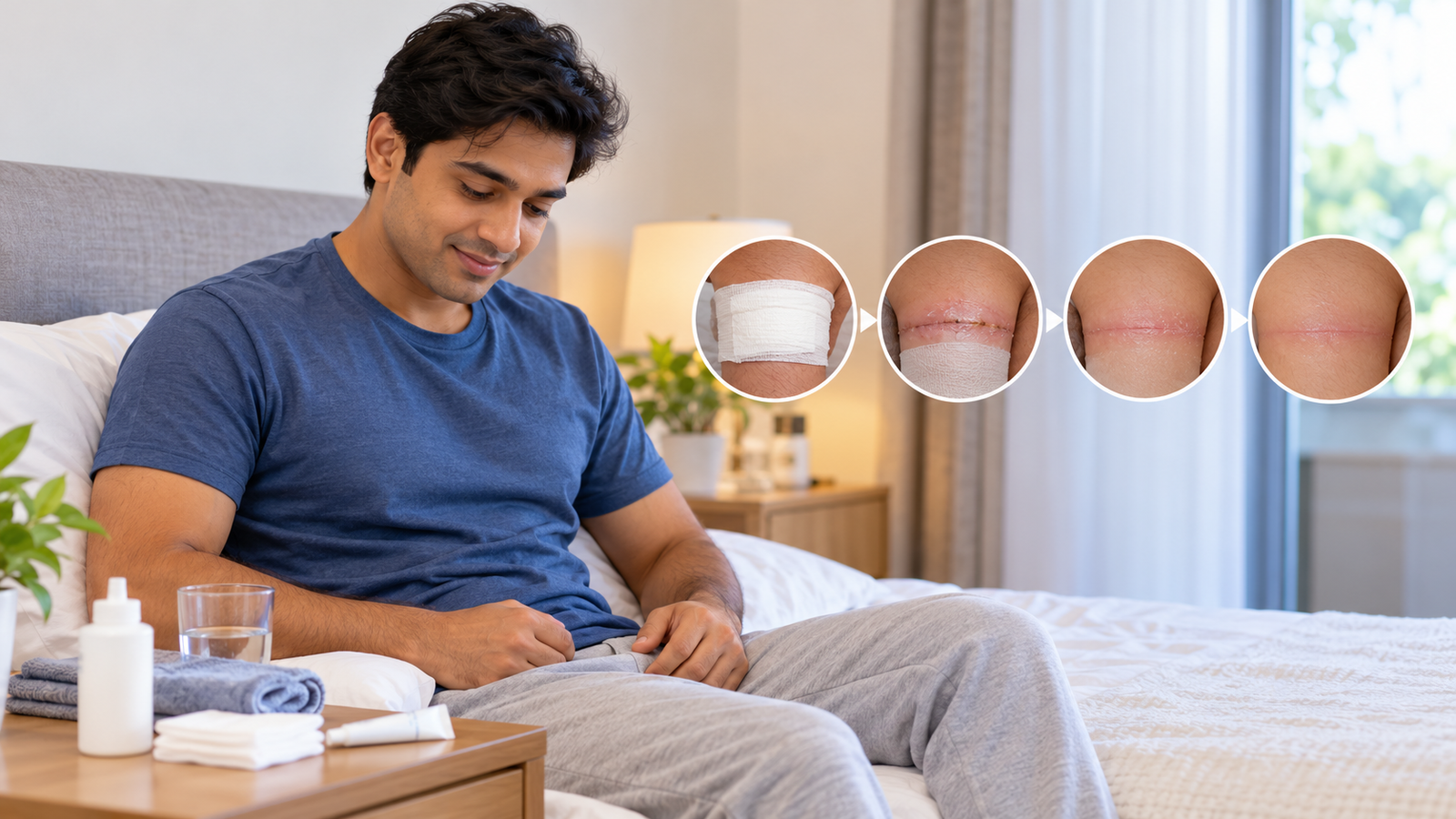
How Long Does Circumcision Recovery Take?
Adult circumcision generally requires several weeks of healing.
During the first few days, patients may experience swelling, tenderness, and minor spotting.
These symptoms should gradually improve.
Substantial wound healing commonly takes approximately four to six weeks.
Doctors usually advise avoiding sexual intercourse and masturbation until the wound heals adequately, often for around four to six weeks.
Patients should follow the surgeon's instructions regarding bathing, dressings, exercise, and follow-up appointments.
Warning Signs After Circumcision
Seek medical attention if you experience:
-
Heavy or persistent bleeding
-
Increasing redness or swelling
-
Fever
-
Pus or concerning discharge
-
Severe or worsening pain
-
Wound separation
-
Difficulty passing urine
Early assessment can help identify complications that require treatment.
Conclusion: Can Circumcision Be Done Without Surgery?
Circumcision cannot be performed without surgery.
Laser, stapler, ring, and conventional techniques all involve removing foreskin tissue.
Terms such as "no-cut," "bloodless," "scarless," and "completely painless" can create unrealistic expectations when clinics use them without explaining the actual procedure.
However, not every foreskin problem requires circumcision.
Selected cases of phimosis may improve with prescribed steroid creams and gentle stretching, while inflammation may respond to appropriate medical treatment.
Foreskin-preserving procedures may also suit some patients, although these are still surgical interventions.
The right question is not simply which circumcision method avoids cutting, but whether circumcision is medically necessary in the first place.
A proper medical assessment helps patients understand their options and choose treatment based on their condition rather than advertising claims.